Showing posts with label Lawrence. Show all posts

Thursday, August 6, 2015

Goats - not Ghosts! -- Franklin Butler Lord's Meadow Edge Farm

In the early morning of October 11, 1907, Rev. John J. Fouse ,  was awakened in his parsonage, across the street from the Lawrence Methodist Episcopal Church, by a noise that seemed to come from the Church.  As he watched, a white figure appeared in the doorway and Rev. Fouse crossed the street to investigate.  What he found was not paranormal.


He discovered that the church's new addition was occupied by a flock of forty angora goats, which had wandered in an open door and settled in for the night.  All but one were asleep.  This story appeared in newspapers as far away as the Cincinnati Times and the Daily Arizona Silver Belt.


The goats had escaped from Franklin Lord's Meadow Edge Farm, where they had been purchased to eat weeds on the lawns and meadows. 

Meadow Edge Farm was part of the Lord Family's extensive holdings in The Branch.  Their property extended from West Broadway (the railroad tracks) all the way to the Hungry Harbor Road.  When the property was purchased, around 1880, The Branch area was part of Queens County, and encompassed the watershed later known as Lord's Woods.


Before Franklin Lord's death in 1908, the farm, raised rare Berkshire pigs, White Leghorn chickens, Guernsey, Jersey, Ayrshire and Holstein dairy cows and, of course, the angora goats.  It  was located on West Broadway, a 337-acre site of meadowlands and forests.  During its years of milk production, which ended with the closing of the dairy farm in 1912 (Brooklyn Daily Eagle, March 5, 1912, p. 14),  it was a consistent winner at the New York State Fair in Syracuse, and at the National Dairy Show in Chicago for excellence in milk and cream. In 1924, the last twenty of the family cows were offered for sale (Daily Review, January 25, 1924). The chickens, which were also award-winning layers, remained well into the 1920s.   In 1926, Lord's sons (S.D., Edward and George) sold the land  to a  real estate syndicate for $2 million.


Brooklyn Daily Eagle, March 5, 1912, p. 14.

Franklin B. Lord, c1900
 (photo courtesy Library of Congress)


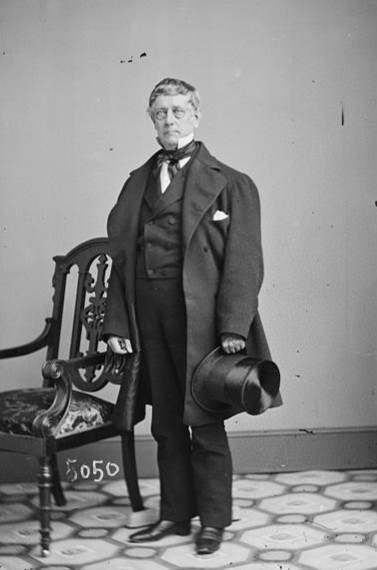
Daniel Lord, c1850
 (photo courtesy Library of Congress)
Franklin Butler Lord (1850-1908) came from a family of distinguished attorneys.  His grandfather, Daniel Lord  , had a national reputation as " a remarkable lawyer."  His maternal grandfather, Benjamin F. Butler, was Attorney General of the United States under Presidents Andrew Jackson and Martin Van Buren.    Franklin Lord was a member of the law firm of Lord, Day and Lord, founded by his grandfather and his father, Daniel de Forest Lord (1846-1899). According to an article in The New York Times  (2/14/1926, p. RE2.), the property was purchased originally by Daniel Lord  for less than $300 an acre, or a total of about $110,000.  It had been in the Lord family for three generations and had been largely undeveloped since its purchase.  By May 1926, advertisements for a public auction of Lord Estate lots were appearing in The Times and other newspapers. 

English and Spanish-style homes designed to sell for less than $12,000 were constructed in 1928.  They were designed to contain six rooms and bath, a built-in standing shower, an extra lavatory and garage. (NYT, 1/17/1928, p.51.)  The seller was listed as the Woodmere-Cedarhurst Corporation. Louis Minsky (1862-1934), the father of the burlesque producing brothers, was the president of the Lord Estate Corporation at the time of his death in 1934 (NYT, 1/17/1934, p. 17).  In 1938, "the Seymour property... known as Sosiego" , twenty acres on Broadway in Lawrence, was purchased by Henry Greenberg and Louis Goldschmidt through Joseph Jackson, a broker, of Lawrence (NYT  7/31/1938, p. 34).  Sosiego was the name of the mansion and gardens built by Daniel D. Lord V, Franklin's brother, and later owned by his daughter Frances Seymour.  (Spinzia, p. 225)  It was located at 20 Westover Place, Lawrence.   The house currently on that site was built in 1921, according to Nassau County tax records.
Blogger S. Berliner shares his thoughts on the Lord's Woods and Robert Arbib's book of the same name.  Arbib, who grew up in the Five Towns of the 1930s and 40s, wrote an evocative account of his formative years exploring the woods, and the process of development that reduced the woods to a small sliver of trees behind the LIPA/National Grid building on Mill Road.

Further reading:
 (may require HW-library card login)


Friday, March 6, 2015

Weaving the Story Mary Kavanagh, Postmaster of Lawrence

Mary Kavanagh, who lived at the turn of the 20th century in Lawrence, New York,  is a mystery waiting to be uncovered.

Alfred Bellot, in his History of the Rockaways (1917), devotes one line to
"the late Mrs. William J. Kavanagh, a resident of Lawrence for many years,and a well-known Indian scholar and literary woman..."
Map of Lawrence, 1891
The only facts related here are 1) Mrs. Kavanagh's husband's name was William J. and 2) she died sometime before 1917.

It was my goal to reconstruct Mrs. Kavanagh's life from readily available Internet sources and subscription databases through the H-WPL database page.    Combined, these individual facts will show that she was a wife and mother, an author, educator and, in an era when women rarely had professions outside the home, she was a notary and Postmaster.


William J.Kavanagh and his wife, Mary lived in the Town of Hempstead (then a part of Queens County)  in the 1880 U.S. Census and the 1892 New York State Census with their four children: 
  • William L. born 1866 (died 1892)
  • Victor Frank, born 1868  (died 1901)
  • Edmund Arthur, born 1873 (died 1935)
  • Mary Gabriella,  born 1876 (died after 1917)
William was born in New York in 1840.  Mary, born in 1834,  emigrated from her native Ireland in 1842.  Working backwards, it was then possible to verify them in the 1870 Census with the two older boys, as resident of New York City.

There are several William Kavanaghs listed as New York Civil War veterans in various databases.  One lived to collect a pension; the beneficiary was his wife Mary.  This William Kavanagh served with several cavalry units, spent some time as a Quartermaster Sergeant and a Regimental Sergeant Major,  and ended the war as a commissioned First Lieutenant.  He lived to collect a pension, of which Mary was the  beneficiary.  This Quartermaster experience may have prepared him for his profession as "leather dealer." (as "our" William is listed in the 1880 U.S. Census).
Articles from local newspapers of the era provided some insight into the lives of the Kavanaghs, who had a home with a beautiful garden in Far Rockaway (South Side Observer, July 7, 1882).  During a crime wave in 1882, the home was the site of an attempted burglary (SSO, October 19, 1882).  That same year, Mrs. Kavanagh purchased the property of Jacob L. Wood in Lawrence (probably located on West Broadway) in the hope of making it "a handsome and very desirable country home." (SSO, April 27, 1882)
Cedarhurst Post Office block, c.1910
In 1883 (SSO, November 17, 1883) Mrs. Kavanagh is credited with "organizing a first class private academy for a limited number of pupils" in Far Rockaway.  The Kavanagh sons established themselves as real estate and insurance brokers in the Branch communities.   William J. was appointed Postmaster of Lawrence in March of 1886.
Unfortunately, the Kavanagh's good fortunes were not to last.   Mention is made of Mrs. Kavanagh in the Brooklyn Daily Eagle of July 13, 1889 as "a lady of fine literary tastes" who, at the time, was suffering from nervous prostration.   In June 1892, the oldest son, William L., died of consumption at the age of 26.  Unable to recover from the loss of his son, William J. fell into a deep melancholy and took his own life the following year.  The elder remaining son, Victor, died of consumption in 1901.
Late 19th Century Postmistresses (Cushing. The Story of our Post Office) 


The appointment of a Postmaster was a political appointment.  Although he only served for one term, Major Kavanagh, a Democrat,  was a respected veteran cited for his integrity and was endorsed for a second term by both parties.  With the election of Grover Cleveland, the widowed Mary Kavanagh was appointed Postmaster of Lawrence in 1893 and again in 1897.

She advertised "two fine homes, fully furnished; all improvements, with stables and five acres of ground, located on main road. in the New York Herald of March 1, 1896 and moved to smaller quarters  on Maple Avenue in Cedarhurst with her daughter, Gabriella.  Mary Kavanagh died in Lawrence on March 26, 1917;  her funeral was held at St. Joachim's Church (Brooklyn Daily Eagle, March 27, 1917, p. 8).(blog updated 5/14/2015)

At the present time, I have not definitively verified a maiden name for Mary Kavanagh, although she is regularly listed as Mary A.S. Kavanagh and she appears as "Mary Ann Stevens O'Reilly Kavanagh" in transcriptions of  birth records of two of her children.  I also have not verified why she was considered an "Indian scholar" by Bellot, though The History of Queens County, New York (Munsell, 1882) refers to her article on another historical subject.   Hopefully, more research will shed more light on this interesting woman and her accomplishments.


Further information:


Friday, April 5, 2013

Fathers of the Five Towns: James E. Gaffney

With the start of this year's baseball season underway, it seems appropriate to reflect on some local baseball history.  In the days when Ty Cobb, Christy Mathewson and Cy Young were active players, James Gaffney exerted great influence in the world of baseball, as a financier and a guy who could make things happen.


The son of Irish immigrants, Gaffney became a Tammany Hall alderman and the owner of  the New York Contracting and Trucking Company, a construction company which handled such projects as the  Pennsylvania Railroad Passenger Terminal (the original Penn Station in Manhattan).  His wife, Essa Irene (nee Smith) was active in the company.  The subject of several newspaper interviews, Mrs. Gaffney is portrayed as beautiful, charming and possessing a keen head for business.   Although his home was in Manhattan, Gaffney owned a Spanish style home on the corner of Broadway and Washington Avenue in Lawrence, where he and his family spent many summers.  


Gaffney's house on Broadway and Washington
Charles F. Murphy, the powerful Tammany Hall boss, was a close friend, and this affiliation brought Gaffney many financial rewards.   Among Gaffney's many business investments were real estate interests in Cedarhurst the Rockaways as well as a string of race horses which were stabled at Gravesend in Brooklyn.  One of these, Irene's Bob (named for his daughter and her husband), was a winner at Saratoga.  The Daily Racing Form reported that Gaffney spent $40,000 in a three month period of 1909, purchasing several fine  race horses.

But baseball became Gaffney's passion.  In 1911,  It was rumored that Gaffney lent money to his friend Clark Griffith, manager of the Washington Senators  to purchase an interest in the team. (McClures Magazine, May-October 1912,  v.39, p. 241).  In December of that year, Gaffney financed the purchase of the Boston National League team for $187,000.  The team had not won since 1898 and Gaffney was prepared to put another $100,000 into it to turn it into a winning team  (Philadelphia Inquirer, 12/23/1911, p. 10).  With his partner John M. Ward, a former player and manager, Gaffney hired a new manager in 1913 (George Stallings) and beefed up the bullpen.   The team, which had been variously named the Beaneaters, the Doves and the Rustlers, now became the Braves.  New York's Tammany Society was named for  Tammany or Tammanend, a Delaware Indian chief, and the members were known as "braves".  The press had named Gaffney "the Brave of Tammany Hall" and Gaffney thought it a great joke to flaunt the New York Democratic machine in the face of the conservative Boston brahmins. 

Ward quickly lost heart and sold out to Gaffney, but the newly-energized team went from last place in early July 1914 to first place at the end of August.  They defeated the New York Giants for the National League pennant and went on to sweep Connie Mack's Philadelphia Athletics in the World Series.  


With this momentum behind the team, Gaffney took the opportunity of creating what was then the largest and most expensive ballpark in the country. Braves Field was to be built about four miles outside of Boston center and would hold 42,282 seats.
Braves Field, c1915

 16,691 [would] be in a one-story grandstand, so constructed that a second deck [might] be added later; 18,015 [would] be built in bleachers back of the first and third bases, admission to which [would]be 50 cents, and 5,336 seats [would] be provided to the right of center field for the 25-cent patrons.  (Idaho Daily Statesman, 12/29/1914, p. 2)

Gaffney wanted the playing field to be large enough so that it would be possible to hit an inside-the-park home run in any of the outfield directions.  He used his connections to erect a departure station within the stadium walls and convinced the Boston Elevated Railway System to construct a closed loop from the Field to the mainline tracks.  Easily accessible by trolley, the new steel stadium was immediately christened "the world's greatest baseball park" by Baseball Magazine.

Unfortunately, the Braves did not live up to their promise and soon declined in popularity.  Gaffney suffered the same fate, as he became implicated in graft and corruption scandals in New York State and gradually faded from the public arena.  The home in Cedarhurst was sold in 1931 to an industrialist and Gaffney died the following year while vacationing in East Hampton.

Visit our local history display on James Gaffney


Lower Level near the Reference Desk

Further Information

Friday, January 25, 2013

Pharmacies in The Branch

The winter months are commonly considered "flu season" in the United States.  Those at risk are advised to avail themselved of "flu shots", vaccinations have been readily available for the past sixty years and antibiotics have been available to combat secondary infections since the 1940s.  Only since the 1980's have strides been made in antiviral medications, which interfere with the life-cycle of the virus itself. 


The 1889 pandemic, known as the Russian Flu, began in Russia and spread rapidly throughout Europe. It reached North America in December 1889 and spread to Latin America and Asia in February 1890. About 1 million people died in this pandemic." The most infamous pandemic was “Spanish Flu” which affected large parts of the world population and is thought to have killed at least 40 million people in 1918-1919


One hundred years ago, medicine could only combat the symptoms of the disease.  The patient's own immune system did most of the work.  Although physicians were available in The Branch, most medicines were dispensed by pharmacists.  Since there was a ready supply of pharmacists from the New York College of Pharmacy (Columbia University) and the Brooklyn College of Pharmacy, The Branch communities had many pharmacies.   What is of interest to this author, however, are the numbers of married couples, both registered pharmacists, who practiced in the area.

Woodmere Pharmacy
George A. Koch, postmaster of Woodsburgh and then Woodmere from 1897-1904, had a small apartment on the second floor of his drug store on the corner of Broadway and Irving Place, where he lived with his wife, Theresa.  Late one night  in August 1904, thieves broke into the store and dynamited the safe inside.  Both Mr. and Mrs. Koch came down armed -- he with a double barreled shotgun -- and engaged the thieves in an exchange of gunfire before they escaped with $750 worth of stamps and $300 in cash.  This was a repeat of an earlier, unsuccessful robbery attempt a month before.  In 1904, Koch sold his Woodmere location and opened a drug store in Far Rockaway, perhaps a more civilized area at the time.

Colonial Pharmacy, Woodmere
William Wisendanger
Estelle V. Wisendanger

William Wisendanger (born 1873; graduated BCP 1895) and his wife, Estelle (nee Vaughan, married 1898) owned and operated the Colonial Pharmacy, located at the corner of Broadway and Irving Place in Woodmere (the same corner if not the same location as the Woodmere Pharmacy).  William, a member of the German Apothocaries Society,  had owned the Rhinelander Pharmacy in Manhattan before moving to Woodmere.

It was Estelle, however, who was the family superstar.  Upon her graduation from NYCP in 1908, Estelle, who placed second in her class, had won the free scholarship prize offered by the Manhattan Pharmaceutical Association. An article in the July 1912 Pharmaceutical Era, highlighted Estelle's accomplishments:
Few women have been the recipient of more conspicuous honors than Mrs Wisendanger.  Her course as a student placed her in the ranks of the exceptional She graduated from Columbia University College of Pharmacy in New York City in the class of 1908 with honors She won the $100 prize for materia medica and pharmacognosy, also the alumni prize: a silver medal and the Kappa Psi gold medal which prize was never before won by a woman She was also the recipient of the Max J Breitenbach prize of $200 for the highest standing in both junior and senior years. Seldom indeed does any one student tower so continually above his or her compeers and her success is a matter of congratulation not only for the student herself but for the profession. Mrs Wisendanger is now a partner in the fine Colonial pharmacy, Woodmere, Long Island with her husband William Wisendanger,  Ph G.   She has full charge of the prescription department.  That a store equipped with the concentrated interest and ability of congenial co-workers should merit confidence and meet with financial success is a foregone conclusion.
By 1913, Estelle was elected president of the New York Women's Pharmaceutical Association and in July of 1914 was one of those on a 55-day European tour sponsored by the German Apothocaries Society when the German army mobilized.  The tour was cut short and the Americans were allowed to leave Germany.

Although she was still in Woodmere in 1935, Estelle Wisendanger is listed as a widow in the 1940 census and had moved to Monroe, NY.


Jennings Pharmacy, Lawrence 
Frank R. Jennings
Eliza  Jennings 
Jennings Pharmacy, c. 1912/ photo: Courtesy Linda Forand

Frank R. Jennings  (born 1877, NYCP 1896), worked with his father in Far Rockaway, until in 1899, when he got a job in Mianus, Connecticut.  In 1900, he married Eliza W. Pettit (born 1877), who became a certified pharmacist in 1904.
 
 Jennings was a member of the King's County Pharmaceutical Society (American Druggist, Jan-June 1908) and opened a new drug store in Lawrence in 1912.  (Druggists Circular, 12/1912). According to family members, it was located at the intersection of the Rockaway-Jamaica Turnpike and the Rockaway Road (today's Broadway) -- a crossroad which had been called "Jennings Corners" since the mid-19th Century.


Over the years, Jennings relocated his store to the corner of Central Avenue and Washington Avenue in Cedarhurst (right) and eventually to Broadway and Franklin Avenue in Hewlett. (Hays Directory, 1945)
After Frank's death, Eliza continued as a pharmacist until she was in her seventies.


Crosby Pharmacy
John D. Crosby
May V. Crosby

   
John D. Crosby was born on his father’s farm at Deerfield, N.Y., May 23, 1858, and attended local schools and theWhitestown Seminary. At the age of twenty-four he left home for Utica,NY, where he was employed in a drug store for three years, after which he came to Inwood, then called Westville.

November 20, 1880, Mr. Crosby married Miss May V. Craft (born 1868, NYCP 1890). Soon after their marriage in 1888, May began the study of pharmacy and graduated from the New York College in 1890. The Crosby Pharmacy was located on McNeil Avenue in Inwood with another location on Bayview Avenue in Lawrence. (1899 Trow's Directory)


When the community got a post office in 1889, Westville's name changed to Inwood.  John Crosby became the first postmaster of Inwood, with population of about eleven hundred. (Newtown Register, 1/14/1889). He remained in that position through World War I.

John D.Crosby is listed in 1904 as treasurer of the newly-formed Queens County Pharmaceutical Association, which boasted 25 members. (William Wisendanger is listed as President)  In March 1907, John Crosby and others listed at a dinner of the Long Island Botanical Association, an organization comprised of all the druggists on the Rockaway Peninsula.


In February 1914 (Pharmaceutical Era), May Crosby is listed as the corresponding secretary of the Women's Pharmaceutical Association of New York; Estelle Wisendanger is the President.)


In addition to pharmaceuticals and patent medicines, drug stores of the early 20th century had elaborate soda fountains.  An area like The Branch, which was noted for its summer tourism, would have been no exception.  An advertisement in the Evening Telegram of March 14, 1923 reports that the Crosby Pharmacy is one of several listed who just bought a NEW KNIGHT fountain and is selling it's old one.


Raeder's Pharmacy, Cedarhurst
Edward M. Raeder 

In addition to sodas, drug stores supplied postcards to the tourist trade.  Many which still exist on the collectibles market bear the name of Raeder's Pharmacy. 

An article in The Pharmaceutical Era, (1909, vol. 41, p. 436),   describes the pharmacy:

"Raeder's Pharmacy in the White Building,Cedarhurst, Long Island, which was recently opened is one of the finest on the Island." 
Edward M Raeder  born c.1878 (NYCP 1898) was the proprietor.


 Further Reading

Tuesday, February 1, 2011

Local Street Names

Every village has a main street.  Some are actually called Main Street, some Broadway, others are completely different.  According to the U.S. Postal Service (MailPro -- November/December 2010), the top five most common street names are Main, Maple, 2nd, Oak, and Park.

Residential builders commonly used names of trees or flowers, states, political figures and even family members  as inspiration for the vast number of street names required to create communities. Many of the streets in the Five Towns were named for early residents of the communities which they helped to establish.  Here are a few of the street names and their origins:
  •  Albro Lane - The Albro Farm appears on the 1891 Wolverton map between the Rockaway Hunting Club and Woodsburgh. George Albro listed his profession as "Oysterman" in the 1880 census.  His son Eugene is listed as an ice man on the 1900 census.
  • Auerbach Lane  -  Joseph Auerbach, (1855-1944) attorney for the Hewlett Bay Company and original owner of Seawane, now the clubhouse of the Seawane Club.
  • Brower Road, Brower's Point Branch - There were so many Browers in the mid-1800's that the area was known as "Brower's Point."
  • Burton Avenue - Robert L. Burton made his fortune in textiles.  In 1901, he purchased the entire village of Woodsburgh from the estate of  Samuel Wood and began the development of his planned community of Woodmere.  He and his brother, John Howes Burton, were both members of the Rockaway Hunting Club and lived in Cedarhurst (later Lawrence).
  • Combs Avenue - The Combs Family has a long history in the area. Alexander Combs is a major property owner on the 1906 Belcher-Hyde map of Woodmere.
  • Conklin Avenue - Joseph Conklin's property is listed  on the 1873 and 1891 maps of Woodsburgh.
  • Everit Avenue  -   Cousin and financial advisor of Carleton Macy, V. Everit Macy was a philanthropist and President of the Westchester Park Commission.  He owned a home in Hewlett Bay Park.
  • Elinor Road - probably named for Elinor Stewart, wife of John Stewart, a Rockaway Hunting Club member and Hewlett Bay Park resident.
  • Finucane Place  - Matthew Finucan owned the land on the 1873 Beers, Comstock and Cline map of Woodsburgh. Thomas Finucan owned local hotels at the turn-of-the century.  He was a colorful character. Contemporary newspaper articles trace his numerous lawsuits and assault bookings.
  • Frost Lane - The Frost family owned land throughout the Branch.  C (Carman) Frost, a bayman,  is listed in the 1873 Beers, Comstock and Cline map of Hewletts as owning property on Broadway.
  • William Gibson lent his own name to the residential area that he started building in 1925.  He named a series of streets after well-known liquor brands:  Haig Road, Dubonnet Road, Carstairs Road, Gordon Road and Wilson Road.
  • Harris Avenue - Tracy Hyde Harris (c1864-1933), an attorney, lived in Hewlett Bay Park.
  • Grant Park - a residential area developed after the Civil War.  Features streets named for Civil War Generals: Hancock Street, Slocum Street, Sheridan Avenue.
  • Hartwell Place - Dr. John D. Hartwell (d.1902) was a respected physician.  He owned property next to Trinity Church on Broadway.
  • Ike Place -  C. (Charles) Ike, a Woodsburgh property owner on the 1873 and 1891 maps, was a bayman, as were generations of his descendants.
  • Johnson Place - Abraham Johnson, a carpenter and his son,Thomas Johnson, had a farm on the site of the current Woodmere Educational Complex.  Abraham Johnson helped to build the current Trinity-St. John's Church building.  Both are buried in the churchyard. 
  • Keene Lane - James Keene and his son, Foxhall, were stock brokers and members of the Rockaway Hunting Club.  Foxhall Keene was an accomplished all-around sportsman. 
  • Lefferts Road - named for Carleton Macy's wife, Helen Lefferts Macy.  
  • Longworth Avenue - The Longworth Family have lived in the community for generations and had large amounts of land around Broadway in Hewlett at the turn of the 20th century. Daniel Longworth donated the land for the site of the first St. Joseph's Church.
  • Macy Drive - Carleton Macy was the President of the Queens Borough Gas and Electric Company, and later was the President of the Hewlett Bay Company, which developed Hewlett Bay Park.  George's Creek (named for George Hewlett) was dredged to create Macy Channel in the hope of creating a direct waterway between Hewlett and Long Beach, deep enough to float large freighters." (Rockaway News, May 1910)
  • Meadowview Avenue - actually overlooked the meadows owned by the Hewlett family prior to the construction of the Hewlett Bay Company homes.
  • Neptune Avenue -  The 1873 Beers, Comstock and; Cline map of Hewletts shows Neptune Avenue intersecting Broadway at the site of the Neptune Hotel.
  • Paine Road - led to the estate of Edward Paine, an investment banker and member of the Rockaway Hunting Club.
  • Porter Place - H. Hobart Porter (1866-1947), mining engineer.  His large Tudor-style home, Lauderdale, still stands in Lawrence.
  • Sage Lane - led to the property of Mr. and Mrs. Russell Sage in back Lawrence.
  • Stevenson Road - Richard W. Stevenson was an attorney and  developer of Hewlett Bay Park, He was a partner of Joseph Auerbach in the purchase of the Hewlett family lands and their transfer to the Hewlett Bay Company.
  • Veeder Lane - led to the estate of Paul Lansing Veeder (c1885-1942) Yale football star and coach. 
  • Voss Avenue - William Voss, a stockbroker built his home, Merriefield,  in Hewlett Bay Park.  His sons were real estate brokers.  Franklin Voss was also an artist, specializing in equestrian scenes, while his sister, Jessie Voss Lewis, was a portrait painter.  The road to the homestead is now called Pleasant Place.
  • Ward Place -The 1906 Belcher-Hyde map of Woodmere shows Thomas Ward's property bordering the estate of Dr. Hartwell and the property belonging to Trinity Church.
  • White Lane- The White family made their fortune in recycling the carcasses of dead livestock from the streets of Brooklyn and transporting them to Barren Island for processing. They owned large tracts of property throughout Cedarhurst and Lawrence, but White Lane was the site of the family home.
  • Wood Lane - Samuel Wood (c1795-1878) grew up on his father's farm in what would become Woodsburgh. He and his brothers were liquor importers; four bachelors who each left their property to their remaining brothers.  Samuel, the last remaining brother, used the money to buy up neighboring farms and build two hotels, the Woodsburgh Pavilion and the Neptune Hotel, and to establish the village of Woodsburgh as a resort community.

Further reading:

  •  Morris, Joel J.  "Hewlett Bay Park: The Hunting Club Connection." The Nassau County Historical Society Journal, volume XLIX (1994), pp.15-26.
  • The lives of many of those mentioned are documented in detail through various articles (marriage announcements, obituaries, etc. in The New York Times* (available through the Library's Proquest Historical Newspapers database*), census records (available through the Library's Heritage Quest* database), archival maps (available through the Library's Historic Map Works* database) and the Brooklyn Daily Eagle (available online through the Brooklyn Public Library's web site)
  •  Meyer, Milton S.  Village of Lawrence, N.Y. : a brief history of a Long Island community.  Lawrence, NY : Village of Lawrence, 1977.
  • Vollono, Millicent.  The Five Towns.  Charleston, S.C. : Arcadia Press, 2010.

  *requires Hewlett-Woodmere Public Library card login


Thursday, December 23, 2010

Old Fashioned Holidays

Currier & Ives print "American Homestead Winter"
One hundred years ago, most of Long Island looked like this scene from a Currier and Ives print.  The occasional "horseless carriage" was  a bother for pedestrians and animals alike, but during the winter months most of the owners of these nuisances stayed in their city homes.  Many of the seasonal vacation homes in The Branch (as the Five Towns were then known) were unheated and early Twentieth Century winters were long and cold -- , few paved roads, no snow blowers, wood and coal stoves...

The December 1910 issues of the Rockaway Journal list some of the holiday festivities for residents of The Branch.
  • Joseph Ueblacker of Lawrence offers a splendid large sleigh for hire for sleighing parties, two or four horses.
  • a Christmas Tree and Carol Festival at St. Johns Church, held for the scholars of the parish school
  • a musical recital by the pupils of Mr. Sigmund Herzog performed at the Olympia Athenaeum on Mott Avenue
  • three events hosted by The Woodmere Country Club, for the entertainment of the members:
    • an "Open House" on December 31st
    • a Bridge Tournament on January 14th
    • a "Stag" with beefsteak supper on January 28th
in addition, the grounds of the Club occupied by the tennis courts are being flooded each cold night to provide a skating rink.
Skaters on the pond, c1906. (Wallace Small, photographer; HWPL collection)

  • Skaters also practiced on Willow Pond, Birch Pond (on the grounds of the Whiton Estate -- now the Stella K. Abraham School), Sage Pond in Lawrence and even Woodmere Bay when it froze!
  • Nebenzahl's Department Store in Far Rockaway suggests last minute gifts in the December 23rd Rockaway Journal (see below).  The first Jewish services in the area were conducted in a room above the store - later the congregation would become Temple Israel.


while their competitors, Mullen and Buckley touted their wares:

 
It seems that gift-giving was no less hectic a century ago.  Advertisements directed at last-minute shoppers abound in the December 15, 1910 New York Times.  Among these are the AutoStrop Safety Razor ("Economy Christmas Gift for Him"),  The Coward Shoe ("a sensible Christmas Gift") and Macy's Toyland ("....delighting the hearts of thousands of children.....a Fairyland of Toys.") Macy's also featured "French Boudoir Novelties (Third Floor)", French Lingerie and Tea and Luncheon Baskets, while B. Altman and Co advertised "real lace pieces suitable for holiday gifts and "footwear for gift purposes" including "plain and embroidered silk hosiery in shades to match costumes and slippers."

Scribner's advertisement for holiday gift books in includes the following titles:
  • African Game Trails by Theodore Roosevelt.      According to official reports THE BEST SELLER of all non-fiction. Splendidly illustrated with photographs by Kermit Roosevelt and others, also with drawings.   $4.00 net     $4.33 postpaid.
  • Peter Pan by James M. Barrie.     with 15 of Arthur Rackham's framous full color  Pictures. A new edition of this classic for children, now famous for both text and illustrations at a moderate price.   $1.50 net

  • The Intimate Life of Alexander Hamilton, by  Dr. Allan McLane Hamilton (his grandson)  based chiefly on family letters, papers and documents never before published and giving views hitherto unobtainable of almost all famous men and women of Hamilton's day.  8 vols.    $3.50 net. Postage extra.