Showing posts with label 1950-1959. Show all posts

Monday, September 22, 2014

The Lennox Shop

 In 1928, Richard Lennox opened the Lennox House shop in a 12-foot by 18-foot cottage on the site of his grandfather's dairy farm.  Lennox created his version of a general store and featured Early American reproduction furniture.  Enhanced with rescued artifacts from the Oliver Hewlett homestead in East Rockaway (demolished in 1936) , it grew into a charming complex of buildings and a mail order business with over 100,000 customers per year.
Richard and Edith Lennox

An article in the December  29, 1994 South Shore Record states that 19 year old Richard Lennox began with a one-fifth interest in the property, a $200 wedding gift, his wife, Edith's $22-a-week secretarial job and his grandmother's signature on a bank loan. With those assets, and a $50 inventory, Lennox expanded the business, created their own brand of Early American furnishings, and expanded the ambiance of the shops. By 1953 was the subject of a feature article in the trade publication Giftwares, which shared Lennox's story, his business philosophy and his techniques for growing his business into the success that it became, attracting shoppers from all over the metropolitan area and mail orders from all over the United States.
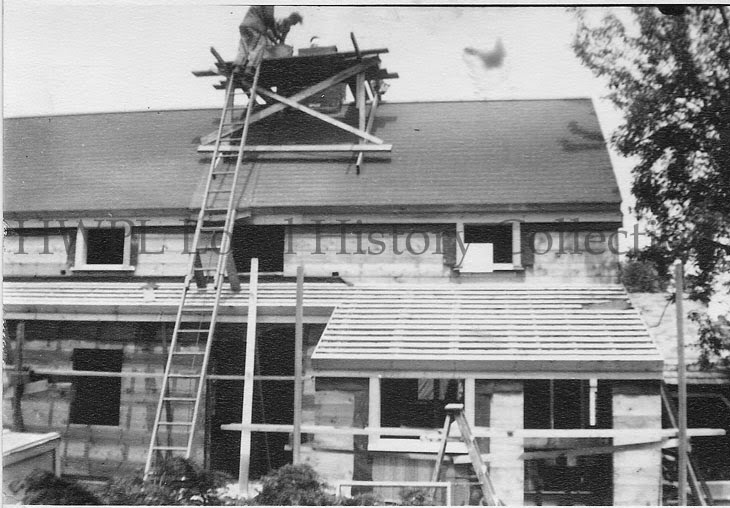


Building the Honeymoon House (c1952).
The shop and its subsequent additions:  Easy Street (which originally featured glassware), the Card Barn, the Fireplace Room, and the Hewlett Room (elegant Early American furnishings) became a fully decorated country home and a showcase for Lennox furniture and decorating services. The 1952 construction of the Honeymoon House enlarged the display and created an environment which those who remember it still miss.


 At this time, the original Seaman homestead (home of Lennox's grandparents) was moved to the corner of Broadway and Trinity Place.   Joan Battino wrote in the December 31, 1998 South Shore Record:
Their home, shop and country store was a great success for more than 70 years.  If ever one needed a special wedding present, a baby gift, a knicknack or just a fun afternoon in a wonderful place to shop, the Lennox Shop was the first place to come to mind.  Christmas transformed the store into Santa's own private haven.  Incense burned throughout, a fire roared in ever fireplace, light hearted holiday tunes were piped into every corner and the shop was decorated from roof to floor plank with pine branches and red ribbons.  No one left without a candy cane.


Richard Lennox died in 1989 and the property was eventually sold to the Hewlett-Woodmere Public Library for its 1994 expansion.


 During this month's exhibit of Five Towns History in the Library's Gallery, we have on display some memorabilia from the Lennox Shop as well as local artist Maxwell Diamond's renditions of views of the Lennox Shops buildings, photographs from the H-WPL collection and examples of work from other local artists.
The late Bob Longworth, a cousin of Richard Lennox, created a miniature reproduction of the original 1928 building in its Christmas glory.
More information:

Battino, Joan. "Lennox Shop remembered in miniature," South Shore Record, December 31, 1998, p. 8.
Namee, M. Virginia.  "The Lennox Shop Story, 1928-1953," Giftwares, November 1953.
"The Way We Were: Lennox House,"  South Shore Record, (date unknown)


Friday, October 10, 2008

The Election of 1952

As the presidential election of 1952 approached, the Cold War was a grave concern for Americans. U.S. troops were engaged in a bloody conflict in Korea; Egypt's King Farouk was ousted by a military coup. King George VI had died, leaving his 25-year old daughter as Queen of England. Senator Joseph McCarthy had been conducting his infamous hearings on Communists in the United States.
Eisenhower campaign button(from the Hudson (OH) Library & Historical Society)


The incumbent president, Harry S. Truman, declined to run for another term. The Democratic party then chose Adlai Stevenson, the intellectual, moderate governor of Illinois to lead its ticket and Sen. John Sparkman of Alabama, a conservative segregationist for its Vice Presidential candidate.


World War II hero, General Dwight David Eisenhower, after being courted by both parties, agreed to run on the Republican ticket, with Richard Nixon as his running mate. Nixon was almost dropped from the ticket, amid allegations of financial misconduct. He attempted to ingratiate himself to the fledgling television audience with his "Checkers" speech and remained on the ticket. Eisenhower, shown here on October 28, 1952 in Lynbrook during a campaign sweep of Nassau County, carried 39 of the 48 states in a landslide victory.


Photo: Max Hubacher (from the H-WPL Local History Collection)


1952 Facts
  • World series: NY Yankees defeated Brooklyn Dodgers (4-3)
  • NBA Championship: Minneapolis Lakers defeated New York Knickerbockers (4-3)

  • The Today Show debuted on NBC with it's host, Dave Garroway
  • Movies: Singin' in the Rain, High Noon, The Greatest Show on Earth, Moulin Rouge, The African Queen
  • Books: Ralph Ellison: Invisible Man; Ernest Hemingway: The Old Man and the Sea; Bernard Malamud: The Natural; Flannery O'Connor: Wise Blood
  • Pulitzer prizes: Fiction: Herman Wouk: The Caine Mutiny; Music: Gail Kubik: Symphony Concertante; Drama: Joseph Kramm: The Shrike
  • Academy award, Best Picture: An American in Paris
  • Nobel Peace Prize: Albert Schweitzer
  • Economics:
1st Class stamp: $.03
Federal debt: $259.1 billion
Unemployment: 3.3%
Average annual salary: $3515
Cost of a gallon of gas: $.20
Average cost of a house: $9,050
Average cost of a car: $1,700


Further Information:

Books of interest at the Hewlett-Woodmere Public Library

From our Online Databases: (requires login)
  • Mayer, George H. "Eisenhower, Dwight David." Encyclopedia Americana. 2008. Grolier Online. 11 Oct. 2008
http://ea.grolier.com/cgi-bin/article?assetid=0139680-00

  • "The Campaign" The New York Times, November 2, 1952, p. E1.
http://proquest.umi.com/pqdweb?did=93588127&sid=1&Fmt=10&clientId=13364&RQT=309&VName=HNP

  • Web Sites
The People History: 1952
Fifties Web: 1952
Wikipedia article on the election of 1952

Monday, March 17, 2008

First Day of Spring 1958

We couldn't resist one more snow scene from our historical collection.
This photograph, taken by Max Hubacher on Friday, March 21, 1958, shows the Gibson Long Island Railroad station after a record snowfall.
As the blizzard paralyzed the Eastern Seaboard, The New York Times reported that the snow was responsible for loss of power to over 150,000 homes on Long Island. At Idlewild Airport, two planes skidded on the runway, collapsing their nose wheels, but without injury.

According to Bosley Crowther's review, the storm marred the opening of Danny Kaye's new movie , "Merry Andrew" and the Easter Show at Radio City Music Hall.

  • The #1 novel on the Times best-seller list was Anatomy of a Murder by Robert Traver.
  • Please Don't Eat the Daisies by Jean Kerr, Art Linkletter's Kid's Say the Darndest Things and Bernard Baruch's My Own Story topped the non-fiction list.
  • A postage stamp cost 3 cents (in August it would go up to 4 cents!!)
  • Billboard magazine hadn't yet produced it's first Top 100 list of popular songs, (That, too, would come in August.)
    Last, but not least, Elvis Presley had just a few more days of civilian life to enjoy before being inducted into the Army, on March 24, 1958.

    It all happened fifty years ago this week!