Showing posts with label 1940-1949. Show all posts

Tuesday, June 28, 2016

Baseball in the Branch

1880, 1889,
Alexander Cartwright published the first rules of baseball for the New York Knickerbockers in 1845.  The game quickly gained popularity and local teams played in community fields all over the country.    


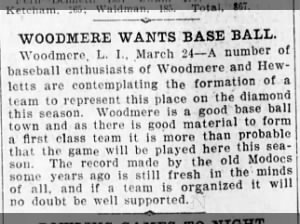
By the 1870's,Woodsburgh had become a popular summer vacation destination and the community formed a team - both for their own pleasure and the entertainment of vacationers.  The Modocs (named for a Native American tribe) were respected competitors and their principal rivals were the Nationals of Pearsalls (today's Lynbrook), the Colonials of Far Rockaway and the Unions of East Rockaway.  

Brooklyn Daily Eagle, September 3, 1895, p. 7

Brooklyn Daily Eagle, March 24, 1904, p.8

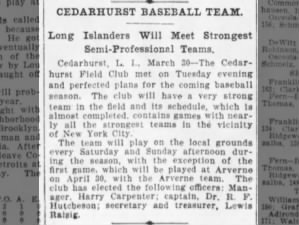
 In 1889, several amateur teams began to explore the possibility of forming a league.  By 1899, six teams,  including Freeport, Hempstead, Valley Stream, Rockville Centre and  Wantagh combined to form the South Side League.  Baldwin and Amityville soon joined, but the Woodmere team did not apply for membership.  However, in 1903, the Cedarhurst team did apply and by 1905, the team proved a formidable opponent in the league.
For ftlh blog July 2016
Brooklyn Daily Eagle, March 30, 1905, p. 11


1900


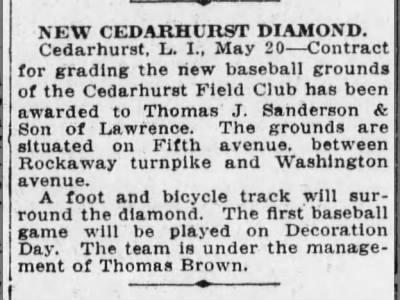
  In 1909, philanthropist Olivia Sage (Mrs. Russell Sage) purchased the Cedarhurst baseball grounds in 1909, for the purpose of erecting affordable housing for working people.  The Cedarhurst Field Club, which had been formed in 1903 played under the management of Thomas J. Brown of Cedarhurst.  Samuel N. Hinckley (1881-1931) eventually a Harvard-educated stock broker and real estate investor, spent three years playing first base with the Cedarhurst semi-professional team.  Cedarhurst Justice of the Peace Lewis Raisig often served as umpire. The team played home games at the Nassau Trade School Field on Lawrence Avenue in Lawrence on Saturdays and holidays until the construction of a new field on Fifth Avenue between Rockaway Turnpike and Washington Avenue in 1915.  Away games were played on Sundays. (BDE, 6/1/1913, p.11)  In 1914, Cedarhurst played Inwood for the Championship of the Rockaway Branch.
    ( BDE 9/16/1914, p. 8)
for ftlh blog July 2016
Brooklyn Daily Eagle, May 20, 1915 – Page 9
The attraction of the local leagues was accessibility and the fun of watching neighbors and friends, but it could not compare to the excitement of the major leagues once they developed.  In 1903, Frank Farrell and Bill Devery purchased the defunct Baltimore franchise of the American League for $18,000 and then move the team to Manhattan.  After 1913 season, this team would be known as the Yankees.  Their popularity and performance increased dramatically after the acquisition of Babe Ruth in 1920.  During the period from 1912 to 1915, James Gaffney of Cedarhurst was the owner of the National League's  Boston Braves.

The "Dead-Ball Era" is the sobriquet usually given to the years between 1900 and 1919, a time of low scoring games.   One source elaborates:
The term also accurately describes the condition of the baseball itself. Baseballs cost three dollars apiece, a hefty sum at the time, which in 1900 would be equal to $85 today; club owners were therefore reluctant to spend much money on new balls if not necessary. It was not unusual for a single baseball to last an entire game. By the end of the game, the ball would be dark with grass, mud, and tobacco juice, and it would be misshapen and lumpy from contact with the bat. Balls were only replaced if they were hit into the crowd and lost, and many clubs employed security guards expressly for the purpose of retrieving balls hit into the stands—a practice unthinkable today.
As a consequence, home runs were rare, and the "inside game" dominated—singles, bunts, stolen bases, the hit-and-run play, and other tactics dominated the strategies of the time.
For amateur and semi-professional teams, the conditions must have been even worse.

In 1937, Max Rosner, owner of the Brooklyn Bushwicks and Bill Leuschner of Nat Strong, Inc.,  organized the Metropolitan Baseball Association for semi pro teams in the Greater New York Area. To qualify, teams had to have a quality home field with lights for night games.  Because of the ban on night games during World War II, the association was suspended, but re-formed in 1946. (Kroessler, p. 125-6.)

The Cedarhurst Municipal Stadium was located near the intersection of Peninsula Boulevard and Rockaway Turnpike, on the site of today's Lawrence Senior High School. It was built by the Village of Cedarhurst in 1937 with workers furnished by the WPA. 
 
Between 1937 and 1941, it hosted semi-professional Metropolitan Baseball League teams, including the New York Black Yankees and the Brooklyn Royal Giants of the Negro National League.  Negro League baseball stars like Marion "Sugar" Caine and Barney Brown played at Cedarhurst during the 1939 season. 

The home team was the Cedarhurst Cedars.


As a young man, Bert Moser played in the minor leagues for a short time.  
"Born on August 6, 1918 in Cedarhurst, he spent his early years watching the teams at Cedarhurst Stadium. According to Bert, they played some of the best teams in their class such as the Bushwicks, House of David, Detroit Clowns, Black Yankees or Giants, Cuban All Stars and Springfield Grays. He would stand out there with a little mitt on Sunday afternoon catching balls, and when the game started sneak up into the stands or sell peanuts." 
(Interview with Bert Moser, Society for American Baseball Research website)  
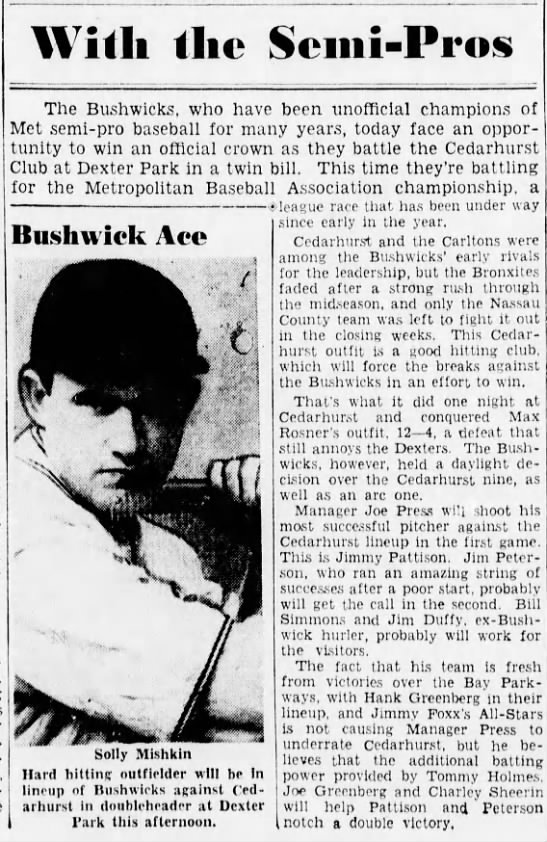
The Brooklyn Daily Eagle, 16 Oct 1938,, Page 39

 The Cedarhurst Baseball Club disbanded in the summer of 1949,  The previous season, the Cedars had reduced their games from three nights a week to just Sunday evenings. While they had one of the top semi-pro teams in the East, they lost many of their players and their fans dwindled to an average of 300 per game. Competition from major league teams, television, and night harness racing ll contributed to the demise of semi-professional baseball in the New York area.  As black baseball players found positions in the major leagues, the stars that made semi-pro baseball a draw were gone and eventually, so was baseball in the Branch.


Further information

Federal Writers' Project (New York). The story of the five towns : Inwood, Lawrence, Cedarhurst, Woodmere and Hewlett, Nassau County, Long Island. [Rockville Centre, NY] : Nassau Daily Review-Star, 1941.

Harvard College. Class of 1905, Secretary's Second Report, p. 123.

Kroessler, Jeffrey A. Greater New York Sport Chronology (New York : Columbia University Press, 2009.)

"Victorious Woodsburghers," Brooklyn Daily Eagle, September 3, 1895, p. 7. 

History of Baseball in the United States  (Wikipedia) 

Cycleback's Online Museum of Early Baseball History Memorabilia 

Secretary's Report Harvard College, Class of 1905 (p. 123) 

Brooklyn Daily Eagle 


Monday, September 22, 2014

The Lennox Shop

 In 1928, Richard Lennox opened the Lennox House shop in a 12-foot by 18-foot cottage on the site of his grandfather's dairy farm.  Lennox created his version of a general store and featured Early American reproduction furniture.  Enhanced with rescued artifacts from the Oliver Hewlett homestead in East Rockaway (demolished in 1936) , it grew into a charming complex of buildings and a mail order business with over 100,000 customers per year.
Richard and Edith Lennox

An article in the December  29, 1994 South Shore Record states that 19 year old Richard Lennox began with a one-fifth interest in the property, a $200 wedding gift, his wife, Edith's $22-a-week secretarial job and his grandmother's signature on a bank loan. With those assets, and a $50 inventory, Lennox expanded the business, created their own brand of Early American furnishings, and expanded the ambiance of the shops. By 1953 was the subject of a feature article in the trade publication Giftwares, which shared Lennox's story, his business philosophy and his techniques for growing his business into the success that it became, attracting shoppers from all over the metropolitan area and mail orders from all over the United States.


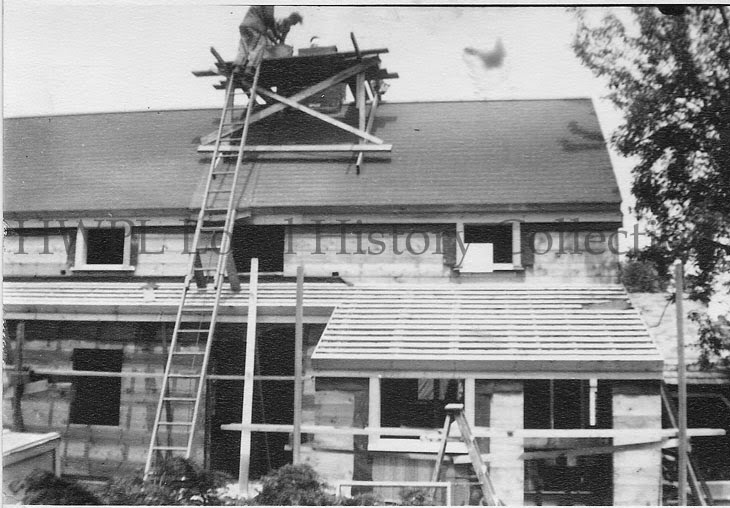
Building the Honeymoon House (c1952).
The shop and its subsequent additions:  Easy Street (which originally featured glassware), the Card Barn, the Fireplace Room, and the Hewlett Room (elegant Early American furnishings) became a fully decorated country home and a showcase for Lennox furniture and decorating services. The 1952 construction of the Honeymoon House enlarged the display and created an environment which those who remember it still miss.


 At this time, the original Seaman homestead (home of Lennox's grandparents) was moved to the corner of Broadway and Trinity Place.   Joan Battino wrote in the December 31, 1998 South Shore Record:
Their home, shop and country store was a great success for more than 70 years.  If ever one needed a special wedding present, a baby gift, a knicknack or just a fun afternoon in a wonderful place to shop, the Lennox Shop was the first place to come to mind.  Christmas transformed the store into Santa's own private haven.  Incense burned throughout, a fire roared in ever fireplace, light hearted holiday tunes were piped into every corner and the shop was decorated from roof to floor plank with pine branches and red ribbons.  No one left without a candy cane.


Richard Lennox died in 1989 and the property was eventually sold to the Hewlett-Woodmere Public Library for its 1994 expansion.


 During this month's exhibit of Five Towns History in the Library's Gallery, we have on display some memorabilia from the Lennox Shop as well as local artist Maxwell Diamond's renditions of views of the Lennox Shops buildings, photographs from the H-WPL collection and examples of work from other local artists.
The late Bob Longworth, a cousin of Richard Lennox, created a miniature reproduction of the original 1928 building in its Christmas glory.
More information:

Battino, Joan. "Lennox Shop remembered in miniature," South Shore Record, December 31, 1998, p. 8.
Namee, M. Virginia.  "The Lennox Shop Story, 1928-1953," Giftwares, November 1953.
"The Way We Were: Lennox House,"  South Shore Record, (date unknown)


Thursday, December 13, 2007

The Blizzard of '47

Gibson LIRR Station, December 27, 1947
Sixty years ago this month, The New York Times headlines read "CITY IS MASTERING RECORD SNOW; BUSES STILL OUT, RAIL LINES GAIN; SUBURBS HARD HIT; 55 DEAD IN EAST".

A major snowstorm hit New York on Friday, December 26, 1947, crippling the metropolitan area for days and eclipsing the "Blizzard of '88". On March 11, 1888, 16.5 inches of snow fell in a 24-hour period, setting a record, and by the time the storm ended, there were 20.9 inches of snow and drifts of up to fifteen feet.

The 1888 mark was surpassed in the first twelve hours of the 1947 storm, and the final total was 26.4 inches. At times, three to four inches fell in an hour in a surprisingly windless sky. In Westchester County, reports the Times, sled caravans in long, winding columns, became the only way that families could shop for food. The roads and public transportation were not available for several days in the pre-Peapod era.

The record remained intact until February 12, 2006, when Central Park recorded a total of almost 27 inches.

The accompanying photo, taken by Max Hubacher, shows the Gibson LIRR station, two days after the storm.
Further information (may require login to Proquest databases)
"Blizzard of '47", The New York Times, December 28, 1947, p. 1.
"Record snowfall buries New York City", CNN.com, February 12, 2006.
"New York City buried under record Snowfall...", Wall Street Journal, December 27, 1947, p. 2.