Showing posts with label 1910-1919. Show all posts

Tuesday, June 28, 2016

Baseball in the Branch

1880, 1889,
Alexander Cartwright published the first rules of baseball for the New York Knickerbockers in 1845.  The game quickly gained popularity and local teams played in community fields all over the country.    


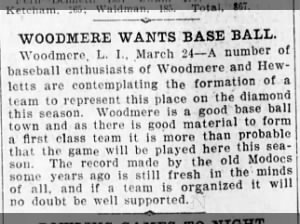
By the 1870's,Woodsburgh had become a popular summer vacation destination and the community formed a team - both for their own pleasure and the entertainment of vacationers.  The Modocs (named for a Native American tribe) were respected competitors and their principal rivals were the Nationals of Pearsalls (today's Lynbrook), the Colonials of Far Rockaway and the Unions of East Rockaway.  

Brooklyn Daily Eagle, September 3, 1895, p. 7

Brooklyn Daily Eagle, March 24, 1904, p.8

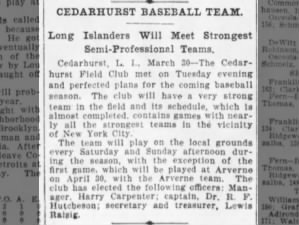
 In 1889, several amateur teams began to explore the possibility of forming a league.  By 1899, six teams,  including Freeport, Hempstead, Valley Stream, Rockville Centre and  Wantagh combined to form the South Side LeagueBaldwin and Amityville soon joined, but the Woodmere team did not apply for membership.  However, in 1903, the Cedarhurst team did apply and by 1905, the team proved a formidable opponent in the league.
For ftlh blog July 2016
Brooklyn Daily Eagle, March 30, 1905, p. 11


1900


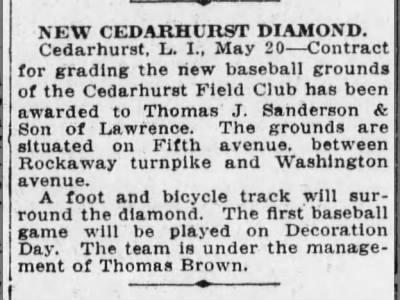
  In 1909, philanthropist Olivia Sage (Mrs. Russell Sage) purchased the Cedarhurst baseball grounds in 1909, for the purpose of erecting affordable housing for working people.  The Cedarhurst Field Club, which had been formed in 1903 played under the management of Thomas J. Brown of Cedarhurst.  Samuel N. Hinckley (1881-1931) eventually a Harvard-educated stock broker and real estate investor, spent three years playing first base with the Cedarhurst semi-professional team.  Cedarhurst Justice of the Peace Lewis Raisig often served as umpire. The team played home games at the Nassau Trade School Field on Lawrence Avenue in Lawrence on Saturdays and holidays until the construction of a new field on Fifth Avenue between Rockaway Turnpike and Washington Avenue in 1915.  Away games were played on Sundays. (BDE, 6/1/1913, p.11)  In 1914, Cedarhurst played Inwood for the Championship of the Rockaway Branch.
    ( BDE 9/16/1914, p. 8)
for ftlh blog July 2016
Brooklyn Daily Eagle, May 20, 1915 – Page 9
The attraction of the local leagues was accessibility and the fun of watching neighbors and friends, but it could not compare to the excitement of the major leagues once they developed.  In 1903, Frank Farrell and Bill Devery purchased the defunct Baltimore franchise of the American League for $18,000 and then move the team to Manhattan.  After 1913 season, this team would be known as the Yankees.  Their popularity and performance increased dramatically after the acquisition of Babe Ruth in 1920.  During the period from 1912 to 1915, James Gaffney of Cedarhurst was the owner of the National League's  Boston Braves.

The "Dead-Ball Era" is the sobriquet usually given to the years between 1900 and 1919, a time of low scoring games.   One source elaborates:
The term also accurately describes the condition of the baseball itself. Baseballs cost three dollars apiece, a hefty sum at the time, which in 1900 would be equal to $85 today; club owners were therefore reluctant to spend much money on new balls if not necessary. It was not unusual for a single baseball to last an entire game. By the end of the game, the ball would be dark with grass, mud, and tobacco juice, and it would be misshapen and lumpy from contact with the bat. Balls were only replaced if they were hit into the crowd and lost, and many clubs employed security guards expressly for the purpose of retrieving balls hit into the stands—a practice unthinkable today.
As a consequence, home runs were rare, and the "inside game" dominated—singles, bunts, stolen bases, the hit-and-run play, and other tactics dominated the strategies of the time.
For amateur and semi-professional teams, the conditions must have been even worse.

In 1937, Max Rosner, owner of the Brooklyn Bushwicks and Bill Leuschner of Nat Strong, Inc.,  organized the Metropolitan Baseball Association for semi pro teams in the Greater New York Area. To qualify, teams had to have a quality home field with lights for night games.  Because of the ban on night games during World War II, the association was suspended, but re-formed in 1946. (Kroessler, p. 125-6.)

The Cedarhurst Municipal Stadium was located near the intersection of Peninsula Boulevard and Rockaway Turnpike, on the site of today's Lawrence Senior High School. It was built by the Village of Cedarhurst in 1937 with workers furnished by the WPA. 
 
Between 1937 and 1941, it hosted semi-professional Metropolitan Baseball League teams, including the New York Black Yankees and the Brooklyn Royal Giants of the Negro National League.  Negro League baseball stars like Marion "Sugar" Caine and Barney Brown played at Cedarhurst during the 1939 season. 

The home team was the Cedarhurst Cedars.


As a young man, Bert Moser played in the minor leagues for a short time.  
"Born on August 6, 1918 in Cedarhurst, he spent his early years watching the teams at Cedarhurst Stadium. According to Bert, they played some of the best teams in their class such as the Bushwicks, House of David, Detroit Clowns, Black Yankees or Giants, Cuban All Stars and Springfield Grays. He would stand out there with a little mitt on Sunday afternoon catching balls, and when the game started sneak up into the stands or sell peanuts." 
(Interview with Bert Moser, Society for American Baseball Research website)  
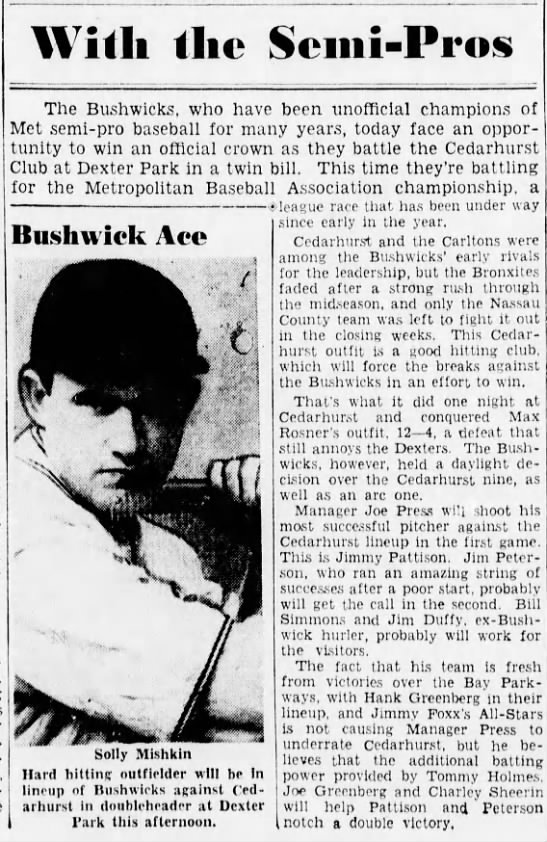
The Brooklyn Daily Eagle, 16 Oct 1938,Page 39

 The Cedarhurst Baseball Club disbanded in the summer of 1949,  The previous season, the Cedars had reduced their games from three nights a week to just Sunday evenings. While they had one of the top semi-pro teams in the East, they lost many of their players and their fans dwindled to an average of 300 per game. Competition from major league teams, television, and night harness racing ll contributed to the demise of semi-professional baseball in the New York area.  As black baseball players found positions in the major leagues, the stars that made semi-pro baseball a draw were gone and eventually, so was baseball in the Branch.


Further information

Federal Writers' Project (New York). The story of the five towns : Inwood, Lawrence, Cedarhurst, Woodmere and Hewlett, Nassau County, Long Island. [Rockville Centre, NY] : Nassau Daily Review-Star, 1941.

Harvard College. Class of 1905, Secretary's Second Report, p. 123.

Kroessler, Jeffrey A. Greater New York Sport Chronology (New York : Columbia University Press, 2009.)

"Victorious Woodsburghers," Brooklyn Daily Eagle, September 3, 1895, p. 7. 

History of Baseball in the United States  (Wikipedia) 

Cycleback's Online Museum of Early Baseball History Memorabilia 

Secretary's Report Harvard College, Class of 1905 (p. 123) 

Brooklyn Daily Eagle 


Wednesday, April 29, 2015

German Spies in Cedarhurst; U-Boats off Long Island


     The sinking of the R.M.S. Lusitania by a German U-boat on May 7, 1915 and the loss of 1,198 lives (among them 128 Americans) was instrumental in the United States declaring war on Germany, but the process was very gradual.   President Woodrow Wilson had, since the outbreak of hostilities in Europe during the summer of 1914, tried to maintain the United States' neutrality.  Although American banks provided financial assistance to its European allies, overt military intervention was not popular.   During the years before the U.S. entered the war in 1917, there was a German consulate in New York, an embassy in Washington, D.C.  and the summer embassy in Newport, R.I. --  long the playground of Vanderbilts and Astors.  Newport was also the home of the U.S. Naval War College (est. 1884) and a major U.S. Navy installation since the 1790s.
Brooklyn Daily Eagle, May 23, 1915
   In 1912 the German communications giant Telefunken funded the construction of a wireless station in Sayville, on Long Island's South Shore (about 50 miles from New York City).  Situated on 100 acres adjoining the Long Island Railroad.  Its two towers, 393 and 100 feet high, were powerful enough to send messages 3,200 miles to the German wireless station at Nauen, near Berlin. 1.  In his article "When Wireless Was Young,"  Wilson L. Glover remembered:
"the overwhelming whine-and-drone [of the Telefunken tower] quite often utterly precluded decent reception of more distant stations.  Anyway, its messages were always in code and so unintelligible that they proved deadly dull reading.  The big German station was a clearing house for a vast network of spies then operating in the United States." 2
     From the start, the station was observed by the Navy Department and the Department of Commerce and Labor.  But the technology was so new that laws had not yet been written to regulate its use. 3Civilian "Ham" radio enthusiasts were asked by the government to  monitor and record the transmissions, which were then decoded by Secret Service agents.  The obituary for Charles Apgar, one of those radio operators 4  recounted how the Secret Service broke the German code and discovered that they were directing the activites of submarines. along the Atlantic coast. Although unsubstantiated, there was a rumor that Apgar's recordings provided the message "Get Lucy," which resulted in the sinking of the Lusitania.
Buffalo Evening News, June 14, 1915, p. 6.
     In the summer of 1915, the German Embassy quietly rented an "unpretentious house on the north side of Central Avenue, two blocks from the railroad station" in Cedarhurst, as its summer residence.  It was described in the Daily Star,  as "a weather-beaten, two story gable-roofed structure, with a large corner lot and a hedge running around the front and western side."  5 About 100 feet from the Embassy was a booth which was continuously manned by Embassy personnel for the transmission and reception of wireless messages to and from the Sayville tower, and ultimately, Berlin.  The ambassador, Count Johann Heinrich von Bernstorff, was rarely at the summer embassy and preferred to return to New York City at the end of the day if he came to Cedarhurst.   As relations with Germany declined, members of the Cedarhurst Country Club rescinded their offer of membership to the embassy staff,  preferring to offer them the services of the club as guests rather than members.  Prince Hartfeld von Trachenberg relaxed by playing croquet on the lawn lawn of the Embassy. 6

 Brooklyn Daily Eagle,  April 24, 1915, p. 1


By 1916, the increasing u-boat activity in the North Atlantic shipping lanes in defiance of international law increased anti-German sentiment in the U.S.  In October of 1916, the submarine U-53 threatened and attacked British and neutral merchant ships off the Nantucket Lightship, within 100 miles of Newport, R.I.  

   During the years preceding the Great War, approximately 100,000 German reservists resided in North and South America.  Although there were plenty of active duty enlisted men in Germany, there was a shortage of officers, and a plan was developed to send as many reserve officers as possible home to Germany.  As early as 1914, agents of the German Embassy bought passports from longshoremen and sailors -- Swedes, Norwegians, Swiss and eventually, even Americans were willing to sell their passports for $25 to $100.  It was easy to substitute a photograph and stamp for the originals and soon a brisk business was underway.  The leader of this network was found to be Franz von Papen, a military attaché with the Embassy in Washington, D.C., but Ambassador von Bernstorff certainly had knowledge of the scheme.  Von Bernstorff, preferring to be involved in the Washington and New York social scenes, was definitely involved in a the appropriation of funds collected  for humanitarian purposes by German-Americans and using the money for pro-German propaganda.
     When it was made public that Germany had invited Mexico to enter the war as Germany's ally against the U.S. 7 and offered  German assistance in  recovering Mexico's former holdings in Texas, New Mexico, and Arizona, even Wilson re-evaluated his position and severed relations with Germany in February 1917.  On April 6, 1917, the United States entered the Great War.

 In addition to the passport plot, the possible targeting of the Lusitania, the misappropriation of the relief funds, the damage done by the German spy network included the destruction of the Vanceboro (Maine) bridge (1915) which linked the U.S. and Canada, the Black Tom ammunition depot in New York Harbor (1916), and plots to bomb Ontario's Welland Canal and to attach "rudder bombs" to the propellers of ships leaving U.S. Pacific ports. Authorities foiled plots in Seattle, San Francisco and Hoboken.  On July 19, 1918, Coast Guard patrols at Fire Island sighted a submarine off  Bay Shore.  Shortly after that, the U.S. cruiser San Diego, was sunk 10 miles off Fire Island.  It was never officially determined whether the cruiser was sunk by a torpedo or by land mines laid by the submarine.  The ship sank in fifteen minutes, resulting in the loss of three lives, although almost all of the crew escaped in lifeboats. Within a month ( August 13) the Norwegian freighter Sommerstad was also sunk of Fire Island, the victim of a German torpedo.

Throughout 1917 and 1918, German agents and propagandists were apprehended throughout the New York area, sent to detention camps on Ellis Island and then to prison.8  The diplomats had either already left or were forced out.  Von Bernstorff returned to Germany with his American wife. 
"Bernstorff served in the Reichstag from 1921 to 1928. A fervent supporter of international cooperation, he was the cofounder and president of the German Association for the League of Nations, president of the World Federation of Associations of the League of Nations, and a member of the German delegation to the League of Nations.  Bernstorff co-chaired the German Pro-Palestinian Committee that supported the establishment of a Jewish state in Palestine and during 1926-1931, he chaired the German delegation to the Preparatory World Disarmament Conference.  Explicitly mentioned by Adolf Hitler as one of those men bearing "guilt and responsibility for the collapse of Germany, Bernstorff fled Germany in 1933 after the Nazis came to power.  He died in exile in Geneva, Switzerland on October 6, 1939."9

Franz von Papen was expelled from the U.S. in 1916 and, after serving in the army and entering German politics, he became its Chancellor in 1932 and Vice-Chancellor under Adolf Hitler in 1933-34. The Nazis soon marginalized the more moderate von Papen and his allies.  He left the government after the Night of the Long Knives.  Von Papen died in West Germany in 1969 at the age of 89.


Links (*access may require HWPL library card)


1 St. Louis Post-Dispatch, August 10, 1912, p. 1.   

2 Long Island Forum , vol. 20 (1957), p. 2+.
3 The New York Tribune, August 10, 1912, p. 3. 4 The New York Times, August 19, 1950, p. 12. 
5 "German Embassy moves to L.I," Daily Star, June 10, 1915, p. 2.

6 "Prince enjoys "Jitney Golf," The Brooklyn Daily Eagle, August 26, 1915, p. 1.
7 The "Zimmerman Telegram" was intercepted by British intelligence in 1917.  
8 "36 German agents off to Oglethorpe," The New York Times, January 20, 1918, p. 4.

9 Tucker, Spencer C. (ed.) Count von Bernstorff in World War I: the Definitive Encyclopedia and Document collection. ABC-CLIO, 2014, p. 248.


Tuesday, February 11, 2014

Woodmere Kennel Club

The February 10th opening of the The Westminster Kennel Club 138th Annual Dog Show at Madison Square Garden brings to mind a little-known treasure of early 20th-century Woodmere -- The Woodmere Kennel Club.

The inhabitants of the Branch communities, home to the Rockaway Hunting Club since 1878, were avid canophiles -- much  like their modern counterparts.  Besides having family pets, many had their own kennels, as well as private stables, in what was then a very rural area.  Long Island dog enthusiasts formed local kennel clubs based on breed or locale and the Woodmere Kennel Club was one of the early clubs in the area.

The Woodmere Club had a small opening show on a rainy May 18th of 1913, but on June 28 of that year, a second show was held on the grounds adjoining the Broadway Central Hotel on Broadway in Woodmere (Rockaway News, July 2, 1913, p. 1). The two-hour long event was held in a tent with two rings.  Best in show was one by Sun of Llenrud, a nineteen-month old British-bred Pekingese owned by Mrs. A. McClure Halley of New York.

A Rockaway News article from June 21, 1913 lists prizes offered for the second event, including:

Bull Terriers:
Mr. Wex Jones offers $2.50 in gold for best brace of Bull Terriers.
Dr. A.C. Daniels offers twelve pounds Puppy Bread for the best puppy dog and twelve pounds for the best bitch.
Bulldogs:Mr. P. Seixas offers Set of Cuff Buttons for best Miniature Bulldog
Dr. A.C. Daniels offers a Mark Cross Safety Razer [sic] for best American bred dog or bitch.

Other classes included Irish Terriers, French Poodles, English Toy Spaniels, Children Classes, Scottish Terriers, Great Danes, Setters, Maltese Terriers, Pekingese Spaniels, Dachshunde, Collies, Toy Poodles.
To be shown by a "lady", the woman must be the dog's owner.

Within a few years, the shows had outgrown the Broadway Central Hotel.  In 1915, shows were held in the ballroom of the Nassau Hotel in Long Beach, the Hoffman House and the Hotel Gregorian (42 West 35th Street) in Manhattan.  The Club held shows at the Hotel Gregorian for many years.

On October 21, 1914, an unusual event was held at the Hotel Gregorian.  Billed as "Dogs in Toyland," the Woodmere Kennel Club held a special show for miniature breeds.  It seems that at a prior show there were issues between on of Charles Ludwig's Great Danes and a Pekingese. So large dogs were not invited to the next event.

In December, James R. Meade, a breeder from Brooklyn, resigned from the presidency of the club, which he had held for three years.    Over 100 members attended his farewell meeting, at which speeches were made and a silver loving cup was presented to Mr. Meade (Brooklyn Daily Eagle, December 22, 1914, p. 2)   Meade, who raised Boston Terriers and Pekingese, resigned his position so that he could devote time to showing his dogs.  One year later, tragedy hit when his entire kennel of Pekingese was lost to an unnamed epidemic.


The Club's new officers of 1914 were overwhelmingly women.  Mrs. M. C. McGlone was elected president; Mrs. J.L. Conklin, Mrs. H. Taylor and Mrs. E. Allis Cox, Vice Presidents;  Mrs. L. Shillings, Treasurer; George Heiline, Secretary.

A 1915 article in The New York Sun (June 27, 1915, p. 16) praises the Club for its activities in bring new breeders and amateurs into the world of dog fancying.  184 entries, a very large number for the time, were judged at one evening show.  In 1915, active members of the Club were working towards running dog shows under the American Kennel Club rules, and granting championship points through that organization.

In the 1930s and 40's local dogs such as the collies of Noranda Kennels, owned by Mrs. and Mrs. William H. Long Jr. of Hewlett Harbor (New York Times, February 2, 1941, p. S6; New York Herald Tribune, February 21, 1937, p.B9A), Hi-Wood Mike, a black Labrador Retriever owned by Mrs. John S. Williams of Hewlett (The New York Times, November 24, 1941, p. 23.) appear as winners of major shows throughout the nation. By that time, the Woodmere Kennel Club seems to have faded into oblivion.  As the "horsey set" moved to the North Shore of Long Island and the residential neighborhoods of the Five Towns no longer welcomed dog kennels, breeders moved farther out on the Island and organizations like the Long Island Kennel Club in Oyster Bay took in the members of many local clubs.

Further Information:

Tuesday, August 27, 2013

Hewlett Embroidery Works

The next time you pass the Hewlett Fire House, to pick up some donuts -- take a moment and look UP!  At the corner of Franklin and Railroad Avenues is a building which displays roofline crenellations, an architectural element more common to castles than to donut shops.  One hundred years ago, it was the site of the Hewlett Embroidery Works.  The firm specialized in Swiss Embroidery  (also called broderie anglais), a white-on-white variety of lace which was very popular in the Edwardian world.


The Hewlett Embroidery Works
was incorporated in New York on May 3, 1911 The firm, whose corporate offices were located on East 18th Street in Manhattan, manufactured and sold embroideries, laces, silk, wool, cotton, linen and other textile fabrics.   The President of the company was Albert Brenwald of Woodmere; Henry Ruppert of New York City is listed as Secretary, and Charles Englehard  of Roselle, NJ as Director.


Brenwald (also spelled Brennwald) (born 1874 in Zurich, Switzerland) emigrated to the U.S. in 1902.  He lived on Brower Avenue with his wife, Anna, and son, Adolph.  He and Ruppert (also a Swiss native) formed their partnership in 1909.  Apparently, Brenwald had the embroidery expertise; his partners had the business experience.


Workers
The 1912 New York State Register of Factories lists a workforce of 6 men and 22 women at the Hewlett Embroidery Works (2). In 1914 a branch site opened at Pitz’s Hall in Lynbrook, which employed 100 female operators (3).


An average female embroidery worker earned about  $387 a year. A two week vacation at half pay was a luxury and any minutes they did not work were deducted from their time at the end of the week. This was an era of sweatshops, where workers tolerated overcrowding, long hours (average 53-hour work-week and low wages in factories  to support themselves and their families.(4)  The 1911 Triangle Factory fire, which took the lives of 146 workers trapped in the burning building, served as a catalyst for better working conditions, through union intervention and government legislation.


As early as 1891, a Ladies’ Home Journal article described a group of embroidery workers who decided that if each worker could spare ten unpaid minutes a day, they could read to each other.  In this way, they got 800 minutes a day, 1800 minutes a week, etc. of reading accomplished during their working hours (5).  In 1900, only 19 percent of women of working age participated in the labor force and children comprised 6 percent of the labor force (6).


Later History of the Company
With the start of World War I, the market for decorative lace diminished.  Over the next few years, the firm’s management changed -- Ruppert is listed as Secretary and Director in 1915. and in 1917 and 1919 , Milton J. Gordon is listed as President and Treasurer (7).  Mary Simon was Secretary and Director in 1918.  Albert Brenwald’s family relocated to Chicago, Illinois, where he died in 1925.


By 1922, The American Textile Reporter lists the Hewlett firm under the name Sands and Appel Embroidery Works .  Sylvester Sands (d.1934) and Moses Appel (c1858-1934) owned several factories in New York City, one of which was involved in a fire in November 1905, which was an eerie harbinger of the Triangle fire (8). The firm was dissolved by Proclamation on March 12, 1926.

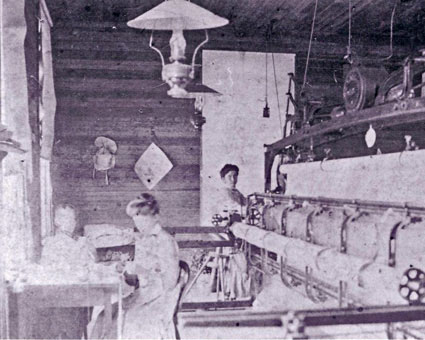
Ladies working at the loom at the Kursheedt embroidery factory in Tennessee.  
The Smith family recruited the factory from New York.  
It made fine Hamburg lace and during World War I, i
t produced patches for military uniforms. (Lewis County Museum)

Further Information:
Endnotes:

Friday, April 5, 2013

Fathers of the Five Towns: James E. Gaffney

With the start of this year's baseball season underway, it seems appropriate to reflect on some local baseball history.  In the days when Ty Cobb, Christy Mathewson and Cy Young were active players, James Gaffney exerted great influence in the world of baseball, as a financier and a guy who could make things happen.


The son of Irish immigrants, Gaffney became a Tammany Hall alderman and the owner of  the New York Contracting and Trucking Company, a construction company which handled such projects as the  Pennsylvania Railroad Passenger Terminal (the original Penn Station in Manhattan).  His wife, Essa Irene (nee Smith) was active in the company.  The subject of several newspaper interviews, Mrs. Gaffney is portrayed as beautiful, charming and possessing a keen head for business.   Although his home was in Manhattan, Gaffney owned a Spanish style home on the corner of Broadway and Washington Avenue in Lawrence, where he and his family spent many summers.  


Gaffney's house on Broadway and Washington
Charles F. Murphy, the powerful Tammany Hall boss, was a close friend, and this affiliation brought Gaffney many financial rewards.   Among Gaffney's many business investments were real estate interests in Cedarhurst the Rockaways as well as a string of race horses which were stabled at Gravesend in Brooklyn.  One of these, Irene's Bob (named for his daughter and her husband), was a winner at Saratoga.  The Daily Racing Form reported that Gaffney spent $40,000 in a three month period of 1909, purchasing several fine  race horses.

But baseball became Gaffney's passion.  In 1911,  It was rumored that Gaffney lent money to his friend Clark Griffith, manager of the Washington Senators  to purchase an interest in the team. (McClures Magazine, May-October 1912,  v.39, p. 241).  In December of that year, Gaffney financed the purchase of the Boston National League team for $187,000.  The team had not won since 1898 and Gaffney was prepared to put another $100,000 into it to turn it into a winning team  (Philadelphia Inquirer, 12/23/1911, p. 10).  With his partner John M. Ward, a former player and manager, Gaffney hired a new manager in 1913 (George Stallings) and beefed up the bullpen.   The team, which had been variously named the Beaneaters, the Doves and the Rustlers, now became the Braves.  New York's Tammany Society was named for  Tammany or Tammanend, a Delaware Indian chief, and the members were known as "braves".  The press had named Gaffney "the Brave of Tammany Hall" and Gaffney thought it a great joke to flaunt the New York Democratic machine in the face of the conservative Boston brahmins. 

Ward quickly lost heart and sold out to Gaffney, but the newly-energized team went from last place in early July 1914 to first place at the end of August.  They defeated the New York Giants for the National League pennant and went on to sweep Connie Mack's Philadelphia Athletics in the World Series.  


With this momentum behind the team, Gaffney took the opportunity of creating what was then the largest and most expensive ballpark in the country. Braves Field was to be built about four miles outside of Boston center and would hold 42,282 seats.
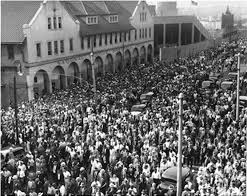
Braves Field, c1915

 16,691 [would] be in a one-story grandstand, so constructed that a second deck [might] be added later; 18,015 [would] be built in bleachers back of the first and third bases, admission to which [would]be 50 cents, and 5,336 seats [would] be provided to the right of center field for the 25-cent patrons.  (Idaho Daily Statesman, 12/29/1914, p. 2)

Gaffney wanted the playing field to be large enough so that it would be possible to hit an inside-the-park home run in any of the outfield directions.  He used his connections to erect a departure station within the stadium walls and convinced the Boston Elevated Railway System to construct a closed loop from the Field to the mainline tracks.  Easily accessible by trolley, the new steel stadium was immediately christened "the world's greatest baseball park" by Baseball Magazine.

Unfortunately, the Braves did not live up to their promise and soon declined in popularity.  Gaffney suffered the same fate, as he became implicated in graft and corruption scandals in New York State and gradually faded from the public arena.  The home in Cedarhurst was sold in 1931 to an industrialist and Gaffney died the following year while vacationing in East Hampton.

Visit our local history display on James Gaffney


Lower Level near the Reference Desk

Further Information