Showing posts with label Fathers of the Five Towns. Show all posts

Friday, February 24, 2017

Fathers of the Five Towns: Harold and Sanford Jacobi


In the early Twentieth Century, the first wave of real estate development in Hewlett saw Carleton Macy's Hewlett Bay Park Corporation erect large homes in varied styles on five-acre plots in what is today the incorporated village of Hewlett Bay Park.  These served as seasonal homes, sometimes rented to other summer vacationers, if their owners planned on yachting at Newport rather than on the Long Island shore.  Most did not have heating plants and so were inhospitable during the colder months.

The area attracted a wealthy population to the area and, to accommodate their lifestyle, facilities like the Seawane Club, the Woodmere Club and the Inwood Club joined the Rockaway Hunting Club in providing recreational services to their clientele.  Mobster Arnold Rothstein opened a beachfront casino at Hewlett Harbor in 1916 and the area was well-known for rum-running in the 1920's.

During the Great Depression of the 1930s, many of the formerly wealthy landowners were forced to sell their property in the "country" and when money again became available, builders and speculators subdivided the large estates and sold them to the new middle class as well as the affluent who had retained their fortunes. 

Sanford Jacobi

Brothers Sanford (1879-1938) and Harold Jacobi (1884-1938), the founders of the Schenley Distillers Corporation, built homes in Hewlett Harbor during the 1930's, on property from several of the original Hewlett Bay Company properties.  With origins in Germany, their grandfather, Simon, (listed as a mohel in census records) emigrated to New Orleans before 1850.   After resettling in New York, the family returned to New Orleans, where Sanford was born.  Emile Jacobi, their father moved the family to Alabama, where the boys grew up.  By they had established themselves in the distilling industry. Their careers brought them to Chicago  and, eventually, New York.  After the  repeal of Prohibition, they became affiliated with the Schenley Products  Company, rising through the ranks to eventually found their own division.


Harold Jacobi house (photo courtesy of Cornell University,
Division of Rare and Manuscript Collections)
Both brothers commissioned houses in Woodmere from designs by Olive Tjaden of Garden City one of only a handful of women who were licensed architects at that time. Harold Jacobi’s house, a Tudor mansion built in 1931, was the subject of a 1935 article in Good Housekeeping.  Attached to her copy of the article, Tjaden was quick to note that she was responsible for the design of the interior woodwork and several interior color schemes attributed to Mrs. Jacobi, in addition to the external features:


 “…[I] also designed the landscaping, which won the Herald Tribune prize.  The site was just a flat, bare several acres of land.  I brought up car loads of Rhodendron [sic] from source also special stone for waterfalls and picturesque pool.  Designed and built greenhouse and cutting gardens, along with new garage, potting rm. and living quarters above.”


Tjaden considered these houses among her major works.  Sanford’s house, built before 1935, was a white Georgian Colonial with extensive gardens.  In her notes, Tjaden describes 10,000 tulips which awaited the installation of statuary.  There was a separate building for the water pumping station which was used for the sprinkler and air conditioning systems.   Tjaden also designed more modest houses on Willow Road in Woodmere for Harold's two daughters.


In Although their principal residences were in Manhattan, both brothers were active in the Five Towns communities.  They were members of Temple Israel in Lawrence and the Woodmere and Inwood Country Clubs.   Since both he and son-in-law Arthur Marks were members of the Inwood Country Club, Harold was probably influential in commissioning Olive Tjaden as the architect  for the 1938 Inwood Beach Club.  Sanford was a Vice President and a Trustee of the Hospital for Joint Diseases in Manhattan.  And both families were active in many Jewish philanthropies.

Harold Jacobi and family
(photo courtesy of American Jewish Historical Society.
Center for Jewish History)


Tragically, Sanford Jacobi died at age 59 in November of 1938 and Harold died of a stroke at the age of 54 a little more than a month later on December 31.  Over 350 attended a memorial service at his home on Short Cut  Road.  Harold's wife, Freda also succumbed to a stroke in January 1939 at the age of 52.   Within a few years, their daughters relocated and the properties were sold. 


In 1941, the firm of Jaeger Brothers purchased both sites, which totaled about 20 acres, from the Jacobi estates.  Bordered on the North and South by East Rockaway Road and Everit Avenue and by Auerbach Avenue and Schenks Lane on the East and West, their development of forty homes was called The Birches at Hewlett Harbor The homes were built on plots which were a minimum of 1/3 acre and sold for between $16,500 and $25,000.


Further information:
  • Guide to the Papers of the Jacobi-Schlossberg Family (American Jewish Historical Society. Center for Jewish History)
  • Olive Tjaden Papers, Division of Rare and Manuscript Collections, Cornell University.
  • "350 Attend Rites for Harold Jacobi," The New York Times, January 3, 1939, p. 17.
  • "Sanford Jacobi, 59, Schenley Official," The New York Times, November 29, 1938, p. 23.
  • "Rites for Mrs. Jacobi," The New York Times, January 21, 1939, p. 15.
  • "Schlossbergs Off for Southland," Newsday, September 11, 1941, p. 19.
  • “Plan Fine Home Community on Hewlett Harbor Estate,” Brooklyn Daily Eagle, April 27, 1941, p. 30.

Wednesday, April 13, 2016

Fathers of the Five Towns: William Adams

Residence of S.F. Morris*, Hewlett 
One hundred years ago, the Branch communities were renowned for their beautiful homes and gardens.  The summer season, which attracted vacationers from all over the world, was the perfect time for gracious outdoor entertaining in these seaside locales, and this was reflected in  grand lawns and spacious areas for entertaining.

Among the celebrated architects creating these magnificent country homes, was William Adams (1870-1956), a resident of Lawrence.

Adams was the grandson of the Rev. William Adams, pastor of the Madison Avenue Presbyterian Church and a founder of Union Theological Seminary.   The younger Adams attended Yale University and later studied at Columbia University's School of Architecture.  According to the Michigan Society of Architects Monthly 30 (April, 1956), p. 11,

"The earliest recorded work by William Adams is the remodelling [sic] of his own house, a handsome Greek Revival residence at No. 23 West 10th Street, in 1893. The following year, he formed a practice, which lasted until at least 1911, with Charles P. Warren and, in association, Professor A.D.F. Hamlin, former head of the School of Architecture at Columbia University."
On New Years Day of 1894, Adams married Boston socialite Alice Cameron Greenleaf.  Their wedding in the Berkshires  was a high point of the New York and Boston society calendars.  Their family soon grew to include three sons: William (b.1894), Lewis Greenleaf (1897-1977), and John Thatcher (b.1908).   By 1900, the couple  had left Manhattan for Lawrence.

William Adams house at 80 Causeway
Adams' house - Living Room


Adams designed and built his home at 80 Causeway, not far from real estate magnates  Samuel P. Hinckley and  Robert Burton, financiers James R. Keene, J. Henry Work, Talbot J. Taylor and Albert Francke.  Francke, a classmate at Yale, was an usher at Adams' wedding.  He was also a client.  The home which Adams designed for Francke, built around 1899, is featured in the January 17, 1912 issue of American Architect and Building News.

William Adams showed a great sensitivity for designing his houses to complement their location, and for the location to enhance the house's design.
"[H]is plans capitalized on their sites, [he was admired] for the straightforward arrangement and good proportion of his rooms, and for the appropriateness of his designs to the Long Island landscape. "  -- MacKay, p. 38
Most of the houses are designed in the Georgian or Federal Revival styles.  
According to MacKay (p.38):
 Houses by Adams have many features in common.  In each, the main public rooms (entry hall, living room, dining room, and den or library) occupy the ground floor of the main block, with sun rooms in one wing and kitchen and service rooms in another wing on the opposite side of the main block. 

In addition to the house designed for  Albert Francke, Adams designed several other houses in the area:
  • with Charles Peck Warren, Federal Revival shingled house with a gambrel roof for Mrs. S.P. Sampson, Lawrence, c.1900
  • for Howard Summers Kniffin, Sr. (1870-1929), financier and partner in Kniffin and  Caffrey (a hemp and jute brokerage firm) at 515 Ocean Avenue, Lawrence.  The house, Restleigh was a Georgian Revival home, built in 1911. The home was later owned by Robert Morrow.
  • for realty broker John F. Scott (d.1934), a brick Federal Revival-style house in Hewlett Bay Park.

House of John F. Scott, Hewlett Bay Park
  • for attorney Norton Perkins, (1875-1925), a partner in McCurdy and Yard, and a trustee of the village of Lawrence. The Georgian Revival-style house, Whale Acres was located at 350 Ocean Avenue in Lawrence and was built c.1914. It was later owned by merchant and financier Samuel Sloan Achincloss, Sr. (1873-1934).
  • for C.Lawrence Perkins, a financier involved with railroads in Hewlett, (American Architect & Building News, January 17, 1912).
  • for financier Alfred Oliphant Norris (b.1901)  at 70 Causeway, Lawrence, in 1897, the house was subsequently purchased by the architect's son, William Adams III (b1895), Landfall   The younger Adams was a capitalist and builder.  He owned the house until 1951, when it was sold to Stephen Baker Finch.  It was renovated in 2006.
  • for stock broker Stuyvesant Fish Morris (d.1925), a descendent of President Martin Van Buren,
    *The photograph labeled "Residence of S.F. Norris" which appears in American Architect and  Building News, January 17, 1912 was, in this author's opinion, the home of Stuyvesant Fish Morris which is located on Everit Avenue between Hewlett Lane and Auerbach Avenue (now 235 Everit Avenue) in Hewlett Bay Park
  • for financier Arthur Nelson Peck, a shingled house, c.1912 on Channel Road in Woodsburgh. Peck was the president of Walters, Peck, and Co., a stock brokerage firm.  The house is featured in a 1912 issue of House Beautiful (v. 31) Feb 1912: 183.

Adams also designed the 1913 Lawrence High School building, the 1914 Woodmere Academy and the No. 4 School in Inwood, which opened in 1911 and is still in use.
Brooklyn Daily Eagle, June 17, 1911, p. 6
 

 A practicing architect for forty years, Adams retired in 1932.  He was a member emeritus of the American Institute of Architects and a member of the University Club of New York and the Rockaway Hunting Club.  William Adams died in 1956 and is buried at Woodlawn Cemetery in the Bronx.


    Further information (some links may require H-WPL library card number)


House of C.Lawrence Perkins, Hewlett

Monday, June 23, 2014

Fathers of the Five Towns: William Soper Pettit

William S. Pettit
(photo courtesy Linda Forand)
From humble beginnings in a family that traced its roots to the earliest settlers of the Town of Hempstead, William Soper Pettit became one of the most respected and influential civic leaders in the New York metropolitan area.


William Pettit was born on January 20, 1880, to Mary Elizabeth Craft and Theodore Edward Pettit.   From the age of 9, he sold newspapers and delivered telegrams at the Cedarhurst LIRR Station.  He was a descendant of Joseph Pettit, the first clerk of Hempstead (about 1657).

After graduating with Far Rockaway High School's Class of 1900,  Pettit went on to attend Columbia University's Law School and was admitted to the bar in 1903.   He authored a book History and Views of the Rockaways, published in 1901.  

Pettit was a leader of the secessionist movement to separate Far Rockaway from New York City and to create a "Rockaway City."  Although the movement was popular and Pettit felt that the legislation's passage was inevitable, it was vetoed by New York's mayor in May 1915.   In 1915, he also served as Special Counsel to the Nassau County Board of Supervisors.  He subsequently served as Chairman of the drafting commission for the Nassau County Charter, Chairman of the Nassau County Child Welfare Board, President of the Nassau County Historical and Genealogical Society and President of the Long Island Y.M.C.A.  In 1920 the Nassau County Republican party backed Pettit in an unsuccessful bid for Justice of the Supreme Court. 
Mary and Theodore Pettit
(courtesy Linda Forand)

In 1925 he won the first Alfred C. Bossom Gold Medallion for distinguished public service by a New York high school graduate.  The award was made for active work in furthering the development of the Rockaways and for leadership in civic and welfare enterprises."  (NYT 5/20/48, p. 60)  When the citizens of Hewlett Neck voted for incorporation of their village (1927), they met at Pettit's home on Barberry Lane in Woodmere.  Pettit was the attorney for the property owners in their quest to have more control over the future of their community.

     During World War I, Pettit headed the local draft board and during World War II, he was chairman of the Lynbrook Ration Board.  He organized the Five Towns War Finance Committee, was a president of the Nassau County Bar Association and a vestryman of Trinity Protestant Episcopal Church in Hewlett (now Trinity-St. Johns) from 1920-1947.  In addition, he was one of the first Trustees of the Hewlett-Woodmere Public Library, when is was established in 1947.


Unfortunately, his illustrious career was cut short in May 1948, when he was killed in a collision with a truck in upstate New York. His wife of forty years, the former Dorothea Smolling, was seriously injured in the accident, but survived.  After his death, his home in Lawrence became the headquarters of the Five Towns YMCA, an institution he helped to found. They had no children.  Mr. and Mrs. Pettit are buried in the family plot in Trinity-St. John's churchyard.


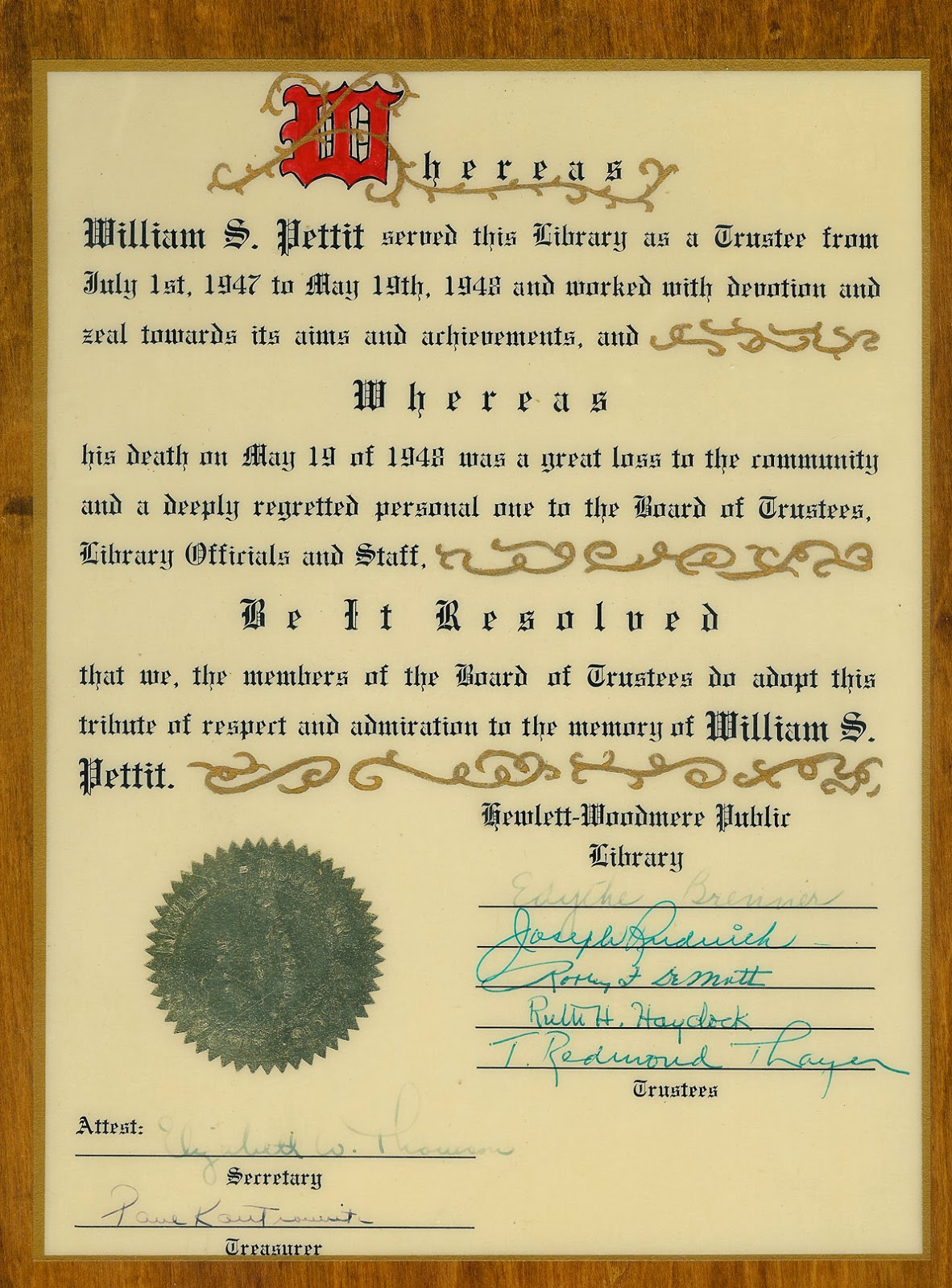
Plaque in honor of W.S. Pettit
from the Trustees of the
 Hewlett-Woodmere Public Library

A 1929 article in the Rockaway Beach Wave listed Pettit's business affiliations:
  • President and Director of the Bus Line Holding Co., Inc.
  • Director and counsel of the National Bank of Far Rockaway,
  • Director and counsel of the Rockaway Beach National Bank
  • Vice President, director and Counsel of Hewlett-Woodmere National Bank
  • Director, Long Beach Trust Co., Vision Realty Corporation, Coney Island Estates, Atlantic Beach Realty Corporation, Madison Mortgage Corporation, Equitable Mortgage and Title Guarantee Co., Darwinian Realty Co., Bay Ocean Realty Association, Boardwalk Associates Inc. and Sarego Realty Co.

Further reading:
Bea Jones. "Nassau Civic Leader Dies in Crash, Newsday, May 20, 1948, p. 3.   (requires HW Library card login)
"Citizens of Hewlett Neck Vote for Incorporation," Long Island Daily Press, February 4, 1927, p. 10.
"Mitchel rejects the Rockaway Bill," The New York Times, May 2, 1915, p. 19.
"W.S. Pettit killed in auto accident," The New York Times, May 20, 1948, p. 60.
William S. Pettit. "The Cornell Cemetery, Far Rockaway," Long Island Forum, August 1946.

Wednesday, June 19, 2013

Fathers of the Five Towns: Isaac D. Levy

Roselle Manor in Cedarhurst, built in the style of an English Renaissance manor house, was the summer home of Isaac D. Levy and his family.  Levy, president of Oppenheim, Collins and Co., a women's specialty department store, lived in the home for over 20 years.

When it was built in the early 1900s,  the mansion was surrounded by five and a half acres at Cedarhurst Avenue and West Broadway.  The $300,000 mansion was designed by the architects Buchman and Fox, and  was landscaped by the firm of Lord and Burnham, who also designed the attached conservatory.   According to Long Island Country Houses and their Architects, 1860-1940:
 the sedate mansion incorporated curved gables, mullioned windows and other motifs of English Renaissance manor houses.   (p.86)
Rosetta and Isaac D. Levy (c1920)

Born in London, Isaac Levy's family came to the United States in 1880.  After a brief stay in New York, they settled in Chicago, where Isaac got a position as a cash boy for $2 a week in the cloak department of The Fair, a popular retail store.  He learned quickly, and by 1891 was a cloak and suit buyer for another large retail establishment.  His experience and innovation earned him a transfer from Chicago to New York.  It was shortly after this that Levy approached Charles J. Oppenheim of Oppenheim Collins with the idea of opening a retail store.  For a business which had formerly catered only to the wholesale trade, this was a major endeavor, but Oppenheim backed Levy's vision and a store on 21st Street and Broadway was quickly replaced by a larger emporium at 35 West 34th Street. 
Oppenheim & Collins' 34th St. store, c1955 (Library of Congress)

In 1902, the "prominent young business man of New York" married "one of the belles in Jewish society circles of the city [Boston]."  The "strikingly handsome" Miss Rosetta Davis and Isaac Levy were wed in a ceremony which was detailed in  the Boston Globe (June 10, 1902, p.8) 


Manhattan changed rapidly during the next few years  years and 34th Street, which had not been a fashionable shopping area, was developing thanks to the efforts of John Howes Burton (another Branch resident) and the Save New York Committee.  The area became second only to Fifth Avenue as a shopping center.

Levy's career took off and their country home was built to accommodate their growing family.  The 1915 New York State census lists the Isaac and Rosetta Levy in Cedarhurst with their daughters, Miriam and Kathleen and a son, Robert.  Another child, Dorothy, had died. An estate the size of Roselle Manor required a staff of eleven living on the property. 


While maintaining their Manhattan apartment, the Levy's summered in Cedarhurst for at least twenty years. But by 1925, they had decided to sell Roselle Manor.  A legal dispute arose between the Levys and their agents, resulting in a 1927 compromise in which Roselle Manor was donated to St. Joseph's Hospital in Far Rockaway as a memorial for Dorothy.  The house was to be used as a convalescent home for children. It was eventually turned over to five trustees to sell and use the proceeds to build a maternity and children's wing for the hospital. The house was eventually demolished in the 1960s.  

After leaving Cedarhurst, the Levys  relocated to Deal, New Jersey, where Isaac Levy died in 1934, after a brief illness. Over 700 people attended the funeral of the man the Brooklyn Daily Eagle called "the prince of merchant princes in the realm of ready-to-wear"   Rabbi Stephen S. Wise, a close friend,  eulogized Mr. Levy as 

an outstanding and revealing personality.    ...What he believed he said and what he said he believed.  He spoke the truth, for he loved the truth and he hated a lie.  He loathed anything that was unfair.  He rose from obscurity to a place of power and distinction in the world of affairs.  His business meant much to him, and he gave unwearyingly [sic] of his time to it, not for his own sake but for the sake of those close to him and for the reputation of his business.  - (The New York Times, September 12, 1934, p. 23)


J.J. Schmidt, whose great-grandmother, Annie Turner (Wallace)  worked at Roselle Manor, has allowed us to use some images from his collection, which show the mansion in its glory days.


Further Information:   (Some links may require HWPL library card login)
"Isaac D. Levy Dies, head of Big Store," The New York Times, September 16, 1934, p. 17.
"Isaac D. Levy, merchant, dies at Home,"  The Brooklyn Daily Eagle, September 10, 1934, p. 7.
"Suit is Turned into $200,000 Hospital Gift, as Litigants Transfer Estate as Memorial," The New York Times, February 22, 1927, p. 21.
"Levy-Davis: Members of Jewish Society of Boston, New York and Philadelphia unite in Celebrating the Event." Boston Daily Globe, June 10, 1902, p. 8.
 

Friday, April 5, 2013

Fathers of the Five Towns: James E. Gaffney

With the start of this year's baseball season underway, it seems appropriate to reflect on some local baseball history.  In the days when Ty Cobb, Christy Mathewson and Cy Young were active players, James Gaffney exerted great influence in the world of baseball, as a financier and a guy who could make things happen.


The son of Irish immigrants, Gaffney became a Tammany Hall alderman and the owner of  the New York Contracting and Trucking Company, a construction company which handled such projects as the  Pennsylvania Railroad Passenger Terminal (the original Penn Station in Manhattan).  His wife, Essa Irene (nee Smith) was active in the company.  The subject of several newspaper interviews, Mrs. Gaffney is portrayed as beautiful, charming and possessing a keen head for business.   Although his home was in Manhattan, Gaffney owned a Spanish style home on the corner of Broadway and Washington Avenue in Lawrence, where he and his family spent many summers.  


Gaffney's house on Broadway and Washington
Charles F. Murphy, the powerful Tammany Hall boss, was a close friend, and this affiliation brought Gaffney many financial rewards.   Among Gaffney's many business investments were real estate interests in Cedarhurst the Rockaways as well as a string of race horses which were stabled at Gravesend in Brooklyn.  One of these, Irene's Bob (named for his daughter and her husband), was a winner at Saratoga.  The Daily Racing Form reported that Gaffney spent $40,000 in a three month period of 1909, purchasing several fine  race horses.

But baseball became Gaffney's passion.  In 1911,  It was rumored that Gaffney lent money to his friend Clark Griffith, manager of the Washington Senators  to purchase an interest in the team. (McClures Magazine, May-October 1912,  v.39, p. 241).  In December of that year, Gaffney financed the purchase of the Boston National League team for $187,000.  The team had not won since 1898 and Gaffney was prepared to put another $100,000 into it to turn it into a winning team  (Philadelphia Inquirer, 12/23/1911, p. 10).  With his partner John M. Ward, a former player and manager, Gaffney hired a new manager in 1913 (George Stallings) and beefed up the bullpen.   The team, which had been variously named the Beaneaters, the Doves and the Rustlers, now became the Braves.  New York's Tammany Society was named for  Tammany or Tammanend, a Delaware Indian chief, and the members were known as "braves".  The press had named Gaffney "the Brave of Tammany Hall" and Gaffney thought it a great joke to flaunt the New York Democratic machine in the face of the conservative Boston brahmins. 

Ward quickly lost heart and sold out to Gaffney, but the newly-energized team went from last place in early July 1914 to first place at the end of August.  They defeated the New York Giants for the National League pennant and went on to sweep Connie Mack's Philadelphia Athletics in the World Series.  


With this momentum behind the team, Gaffney took the opportunity of creating what was then the largest and most expensive ballpark in the country. Braves Field was to be built about four miles outside of Boston center and would hold 42,282 seats.
Braves Field, c1915

 16,691 [would] be in a one-story grandstand, so constructed that a second deck [might] be added later; 18,015 [would] be built in bleachers back of the first and third bases, admission to which [would]be 50 cents, and 5,336 seats [would] be provided to the right of center field for the 25-cent patrons.  (Idaho Daily Statesman, 12/29/1914, p. 2)

Gaffney wanted the playing field to be large enough so that it would be possible to hit an inside-the-park home run in any of the outfield directions.  He used his connections to erect a departure station within the stadium walls and convinced the Boston Elevated Railway System to construct a closed loop from the Field to the mainline tracks.  Easily accessible by trolley, the new steel stadium was immediately christened "the world's greatest baseball park" by Baseball Magazine.

Unfortunately, the Braves did not live up to their promise and soon declined in popularity.  Gaffney suffered the same fate, as he became implicated in graft and corruption scandals in New York State and gradually faded from the public arena.  The home in Cedarhurst was sold in 1931 to an industrialist and Gaffney died the following year while vacationing in East Hampton.

Visit our local history display on James Gaffney


Lower Level near the Reference Desk

Further Information

Tuesday, April 17, 2012

Fathers of the Five Towns: Henry Ziegler

In the last paragraph of a 1909 article in The New York Times  describing the sale of the town of Woodmere to Maximilian Morgenthau's  syndicate of real estate developers, Henry Ziegler (1858-1930) is listed as one of the "present residents of Woodmere and its vicinity."  He is also listed (erroneously) as the President of the Steinway Piano Company.  Although he was a director of the company for many years and the vice president of Steinway & Sons, he declined the presidency of the company which his grandfather, Henry Engelhard Steinway, had founded. 

Trained as a cabinet maker in his father's shop on Bleeker Street Henry's uncle,  C.F. Theodore Steinway discovered the creativity and innovation in his young nephew and took him under his wing.  Steinway became Ziegler's mentor and from 1875 until Mr. Steinway's death in 1889 he received daily instruction from his uncle (one of the masters of the piano industry) in the art of piano construction.  Henry Ziegler became a keen judge of tonal values and patented many inventions which improved and refined the tonal quality and resonance of Steinway pianos.  When he died in 1930 at the age of 72,  his Times obituary described him as

"one of the few men in the piano industry to envision the part which the science of electronics may be destined to contribute to the development of musical instruments ..."

A member of the Rockaway Hunting Club and New York Athletic Club, Ziegler owned a home on Woodmere Boulevard in Woodsburgh.  He raced his own horses in harness-racing competitions.  A small article in the April 12, 1910 Brooklyn Daily Eagle reported a robbery of "considerable jewelry, a fur overcoat and other articles" from the Woodsburgh home while the family was at dinner. Married to the former Albertine Vogel (1863-1934), their son, Frederick J. Ziegler (1886-1966) was a 1908 graduate of Harvard University.  A sculptor and director of Steinway and Sons, Frederick spent his early years in Woodsburgh.  Their daughter, Eleanor Ziegler Hill, died in 1902.

The Steinway Company remained in the extended Steinway family until 1972, when it was sold to CBS Corporation.  In 1995,CBS sold the company to Selmer Industries.  Henry Ziegler Steinway, nephew of Henry Ziegler, was Steinway's president from 1955 until 1972.  In 2008, H.Z. Steinway was awarded the National Medal of Arts, the government's highest award in the arts, by President Bush.   He remained a guiding force in American music until his death in 2008 at the age of 93.


Further Reading:
  • Dolge, Alfred. Pianos and their Makers. New York : Dover Press, 1972.
  • Lieberman, Richard K. Steinway & Sons. New Haven : Yale University Press, 1995.
  • Ratcliffe, Ronald V. Steinway & Sons. San Francisco: Chronicle Books, 1989.
 "Beginning eight days after the first shots of the American Civil War were fired and three days before his wedding, William Steinway's diary bears witness to one of the most dynamic periods in American history. The breadth and depth of material covered sheds light on thousands of people, places, and events as seen through the eyes of this key figure in the cultural, political, financial, and physical development of New York City."   (Smithsonian web site)

Sunday, February 26, 2012

Fathers of the Five Towns: James Alexander McCrea

          Western Long Island at the turn of the Twentieth Century was losing its rural character and beginning its path to suburbia.  Land development companies bought parcels of farmland and subdivided them  -- sometimes into great estates, often into more moderate plots where vacationers might enjoy the life of a country gentleman-- if only for a summer.  The development of railroads during the late 19th century made it an easy prospect for businessmen to travel to Manhattan from most of  Long Island and, after the electrification of the Long Island Railroad in 1905, development increased extensively.

James Alexander McCrea house, Woodsburgh
  
  In 1901, Robert Burton began the residential development of Woodmere in earnest.  His vision of a community where residents could find reasonably-priced, well-appointed homes in close proximity to quality shops, schools, transportation and utilities was well under way when in 1909, he sold the entire town to a consortium headed by Maximilian Morgenthau, who was by then a powerful force in Manhattan real estate.  In the years that followed, a residential section of Woodmere decided to incorporate under the name of Woodsburgh, thus ensuring better services and utilities than the newly-formed county of Nassau could provide.

James A. McCrea
The beauty of the Rockaways and its proximity to "The City" made Woodsburgh a very desirable area for financiers, industrialists and professionals.   James A. McCrea was one of them.  In  about 1909 he hired architect Charles A. Platt to design his Neo-Georgian house on South End Road in Woodsburgh.  A member of the Rockaway Hunting Club and the Cedarhurst Yacht Club, James McCrea was well-acquainted with the Five Towns area (then known as The Branch).  He maintained the home in Woodsburgh in addition to his Park Avenue apartment, which he shared with his wife, Mable (nee Clarke; married 1897) and his children -- sons, James and Charles, and daughter, Agnes.  Between 1912 and 1914, McCrae served as the first President ( the title of Mayor had not yet been established) of the newly Incorporated Village of Woodsburgh, and was a Trustee of the village from 1914-1918.

During his time in Woodmere, James Alexander McCrea  (born in Philadelphia, PA on May 26, 1875) held the position of General Superintendent of the Long Island Railroad.  The son of James McCrea, President of the Pennsylvania Railroad, the younger McCrea graduated in Yale's Class of 1895 with a Bachelor's in Philosophy.  Trained as a civil engineer, he too was employed by the Pennsylvania Railroad before joining the LIRR. 

McCrea entered World War I in October of 1917 as a Major in the Engineering  Corps and was rapidly promoted to Colonel in the Railroad Transportation Corps.  He was Manager of Transportation for the American Expeditionary Force (A.E.F)  and eventually attained the rank of Deputy-General in the zone of Advance.  He earned the Distinguished Service Medal for his services on the staff of Brig. Gen. W. W. Atterbury, Director General of Transportation of the AEF.  When he left the army in 1919, he was elected a Vice President of the Bankers' Trust Company of New York.  (United States Investor, July 19, 1919, p.1538.)  In October 1920, McCrea rejoined the Pennsylvania Railroad as Vice President in charge of the Central Region.  McCrea died of pneumonia in Pittsburgh, PA in 1923.

McCrea's Woodmere home, which was Platt's only South Shore design,  is described in  Long Island Country Houses and their Architects, 1860-1940 ( p. 348):

A seven-bay, two-and-a-half-story central section was flanked by two-story wings of three or four bays in width, one devoted to service, the other designed for a drawing room with bedrooms above.  The interior plan ...emphasized a dominant short axis from entrance hall to rear loggia, crossed by perpendicular corridors to connect major rooms on the first and second floors.  The relation of the house to its surroundings was zoned with an entrance on the north, a vista across open lawns to the water on the south, a formal flower garden to the west, and a service court to the east.
Floor Plan of the McCrea house, 1909

After McCrea's death, the property, subsequently named "Holmeridge" was purchased by John Holme Ballantine II (1892-1976), president and director of the Neptune Meter (later Neptune International Corp. ) Company.  Although the address is listed as "South End Road, Woodsburgh," on the 1920 and 1930 census, the street was not today's South End in Woodmere, but rather in  the area of Ivy Hill Road between Channel Road and Willow Road.  An angular stand of trees marks the border of the original property. The house was demolished circa 1960.


Further reading: