Showing posts with label Baseball. Show all posts

Tuesday, June 28, 2016

Baseball in the Branch

1880, 1889,
Alexander Cartwright published the first rules of baseball for the New York Knickerbockers in 1845.  The game quickly gained popularity and local teams played in community fields all over the country.    


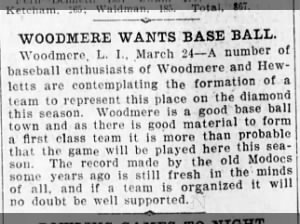
By the 1870's,Woodsburgh had become a popular summer vacation destination and the community formed a team - both for their own pleasure and the entertainment of vacationers.  The Modocs (named for a Native American tribe) were respected competitors and their principal rivals were the Nationals of Pearsalls (today's Lynbrook), the Colonials of Far Rockaway and the Unions of East Rockaway.  

Brooklyn Daily Eagle, September 3, 1895, p. 7

Brooklyn Daily Eagle, March 24, 1904, p.8

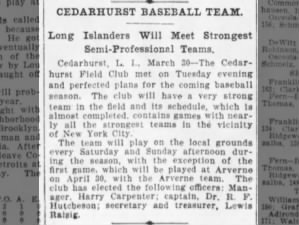
 In 1889, several amateur teams began to explore the possibility of forming a league.  By 1899, six teams,  including Freeport, Hempstead, Valley Stream, Rockville Centre and  Wantagh combined to form the South Side LeagueBaldwin and Amityville soon joined, but the Woodmere team did not apply for membership.  However, in 1903, the Cedarhurst team did apply and by 1905, the team proved a formidable opponent in the league.
For ftlh blog July 2016
Brooklyn Daily Eagle, March 30, 1905, p. 11


1900


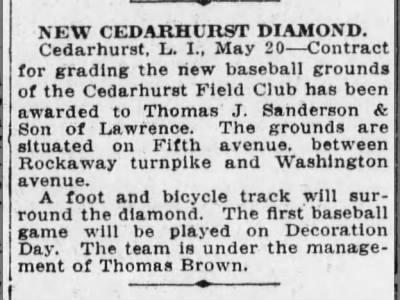
  In 1909, philanthropist Olivia Sage (Mrs. Russell Sage) purchased the Cedarhurst baseball grounds in 1909, for the purpose of erecting affordable housing for working people.  The Cedarhurst Field Club, which had been formed in 1903 played under the management of Thomas J. Brown of Cedarhurst.  Samuel N. Hinckley (1881-1931) eventually a Harvard-educated stock broker and real estate investor, spent three years playing first base with the Cedarhurst semi-professional team.  Cedarhurst Justice of the Peace Lewis Raisig often served as umpire. The team played home games at the Nassau Trade School Field on Lawrence Avenue in Lawrence on Saturdays and holidays until the construction of a new field on Fifth Avenue between Rockaway Turnpike and Washington Avenue in 1915.  Away games were played on Sundays. (BDE, 6/1/1913, p.11)  In 1914, Cedarhurst played Inwood for the Championship of the Rockaway Branch.
    ( BDE 9/16/1914, p. 8)
for ftlh blog July 2016
Brooklyn Daily Eagle, May 20, 1915 – Page 9
The attraction of the local leagues was accessibility and the fun of watching neighbors and friends, but it could not compare to the excitement of the major leagues once they developed.  In 1903, Frank Farrell and Bill Devery purchased the defunct Baltimore franchise of the American League for $18,000 and then move the team to Manhattan.  After 1913 season, this team would be known as the Yankees.  Their popularity and performance increased dramatically after the acquisition of Babe Ruth in 1920.  During the period from 1912 to 1915, James Gaffney of Cedarhurst was the owner of the National League's  Boston Braves.

The "Dead-Ball Era" is the sobriquet usually given to the years between 1900 and 1919, a time of low scoring games.   One source elaborates:
The term also accurately describes the condition of the baseball itself. Baseballs cost three dollars apiece, a hefty sum at the time, which in 1900 would be equal to $85 today; club owners were therefore reluctant to spend much money on new balls if not necessary. It was not unusual for a single baseball to last an entire game. By the end of the game, the ball would be dark with grass, mud, and tobacco juice, and it would be misshapen and lumpy from contact with the bat. Balls were only replaced if they were hit into the crowd and lost, and many clubs employed security guards expressly for the purpose of retrieving balls hit into the stands—a practice unthinkable today.
As a consequence, home runs were rare, and the "inside game" dominated—singles, bunts, stolen bases, the hit-and-run play, and other tactics dominated the strategies of the time.
For amateur and semi-professional teams, the conditions must have been even worse.

In 1937, Max Rosner, owner of the Brooklyn Bushwicks and Bill Leuschner of Nat Strong, Inc.,  organized the Metropolitan Baseball Association for semi pro teams in the Greater New York Area. To qualify, teams had to have a quality home field with lights for night games.  Because of the ban on night games during World War II, the association was suspended, but re-formed in 1946. (Kroessler, p. 125-6.)

The Cedarhurst Municipal Stadium was located near the intersection of Peninsula Boulevard and Rockaway Turnpike, on the site of today's Lawrence Senior High School. It was built by the Village of Cedarhurst in 1937 with workers furnished by the WPA. 
 
Between 1937 and 1941, it hosted semi-professional Metropolitan Baseball League teams, including the New York Black Yankees and the Brooklyn Royal Giants of the Negro National League.  Negro League baseball stars like Marion "Sugar" Caine and Barney Brown played at Cedarhurst during the 1939 season. 

The home team was the Cedarhurst Cedars.


As a young man, Bert Moser played in the minor leagues for a short time.  
"Born on August 6, 1918 in Cedarhurst, he spent his early years watching the teams at Cedarhurst Stadium. According to Bert, they played some of the best teams in their class such as the Bushwicks, House of David, Detroit Clowns, Black Yankees or Giants, Cuban All Stars and Springfield Grays. He would stand out there with a little mitt on Sunday afternoon catching balls, and when the game started sneak up into the stands or sell peanuts." 
(Interview with Bert Moser, Society for American Baseball Research website)  
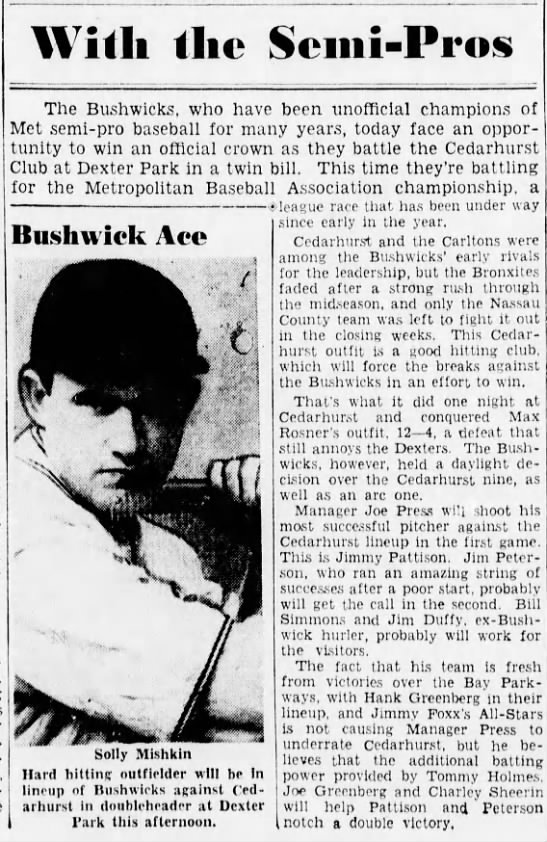
The Brooklyn Daily Eagle, 16 Oct 1938,Page 39

 The Cedarhurst Baseball Club disbanded in the summer of 1949,  The previous season, the Cedars had reduced their games from three nights a week to just Sunday evenings. While they had one of the top semi-pro teams in the East, they lost many of their players and their fans dwindled to an average of 300 per game. Competition from major league teams, television, and night harness racing ll contributed to the demise of semi-professional baseball in the New York area.  As black baseball players found positions in the major leagues, the stars that made semi-pro baseball a draw were gone and eventually, so was baseball in the Branch.


Further information

Federal Writers' Project (New York). The story of the five towns : Inwood, Lawrence, Cedarhurst, Woodmere and Hewlett, Nassau County, Long Island. [Rockville Centre, NY] : Nassau Daily Review-Star, 1941.

Harvard College. Class of 1905, Secretary's Second Report, p. 123.

Kroessler, Jeffrey A. Greater New York Sport Chronology (New York : Columbia University Press, 2009.)

"Victorious Woodsburghers," Brooklyn Daily Eagle, September 3, 1895, p. 7. 

History of Baseball in the United States  (Wikipedia) 

Cycleback's Online Museum of Early Baseball History Memorabilia 

Secretary's Report Harvard College, Class of 1905 (p. 123) 

Brooklyn Daily Eagle 


Friday, April 5, 2013

Fathers of the Five Towns: James E. Gaffney

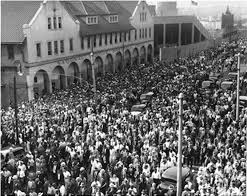
With the start of this year's baseball season underway, it seems appropriate to reflect on some local baseball history.  In the days when Ty Cobb, Christy Mathewson and Cy Young were active players, James Gaffney exerted great influence in the world of baseball, as a financier and a guy who could make things happen.


The son of Irish immigrants, Gaffney became a Tammany Hall alderman and the owner of  the New York Contracting and Trucking Company, a construction company which handled such projects as the  Pennsylvania Railroad Passenger Terminal (the original Penn Station in Manhattan).  His wife, Essa Irene (nee Smith) was active in the company.  The subject of several newspaper interviews, Mrs. Gaffney is portrayed as beautiful, charming and possessing a keen head for business.   Although his home was in Manhattan, Gaffney owned a Spanish style home on the corner of Broadway and Washington Avenue in Lawrence, where he and his family spent many summers.  


Gaffney's house on Broadway and Washington
Charles F. Murphy, the powerful Tammany Hall boss, was a close friend, and this affiliation brought Gaffney many financial rewards.   Among Gaffney's many business investments were real estate interests in Cedarhurst the Rockaways as well as a string of race horses which were stabled at Gravesend in Brooklyn.  One of these, Irene's Bob (named for his daughter and her husband), was a winner at Saratoga.  The Daily Racing Form reported that Gaffney spent $40,000 in a three month period of 1909, purchasing several fine  race horses.

But baseball became Gaffney's passion.  In 1911,  It was rumored that Gaffney lent money to his friend Clark Griffith, manager of the Washington Senators  to purchase an interest in the team. (McClures Magazine, May-October 1912,  v.39, p. 241).  In December of that year, Gaffney financed the purchase of the Boston National League team for $187,000.  The team had not won since 1898 and Gaffney was prepared to put another $100,000 into it to turn it into a winning team  (Philadelphia Inquirer, 12/23/1911, p. 10).  With his partner John M. Ward, a former player and manager, Gaffney hired a new manager in 1913 (George Stallings) and beefed up the bullpen.   The team, which had been variously named the Beaneaters, the Doves and the Rustlers, now became the Braves.  New York's Tammany Society was named for  Tammany or Tammanend, a Delaware Indian chief, and the members were known as "braves".  The press had named Gaffney "the Brave of Tammany Hall" and Gaffney thought it a great joke to flaunt the New York Democratic machine in the face of the conservative Boston brahmins. 

Ward quickly lost heart and sold out to Gaffney, but the newly-energized team went from last place in early July 1914 to first place at the end of August.  They defeated the New York Giants for the National League pennant and went on to sweep Connie Mack's Philadelphia Athletics in the World Series.  


With this momentum behind the team, Gaffney took the opportunity of creating what was then the largest and most expensive ballpark in the country. Braves Field was to be built about four miles outside of Boston center and would hold 42,282 seats.
Braves Field, c1915

 16,691 [would] be in a one-story grandstand, so constructed that a second deck [might] be added later; 18,015 [would] be built in bleachers back of the first and third bases, admission to which [would]be 50 cents, and 5,336 seats [would] be provided to the right of center field for the 25-cent patrons.  (Idaho Daily Statesman, 12/29/1914, p. 2)

Gaffney wanted the playing field to be large enough so that it would be possible to hit an inside-the-park home run in any of the outfield directions.  He used his connections to erect a departure station within the stadium walls and convinced the Boston Elevated Railway System to construct a closed loop from the Field to the mainline tracks.  Easily accessible by trolley, the new steel stadium was immediately christened "the world's greatest baseball park" by Baseball Magazine.

Unfortunately, the Braves did not live up to their promise and soon declined in popularity.  Gaffney suffered the same fate, as he became implicated in graft and corruption scandals in New York State and gradually faded from the public arena.  The home in Cedarhurst was sold in 1931 to an industrialist and Gaffney died the following year while vacationing in East Hampton.

Visit our local history display on James Gaffney


Lower Level near the Reference Desk

Further Information